REVIEW · TOURS
Fatima Neighborhood and Church Unit Bike Tour
Brasília makes more sense from a bicycle seat. This three-hour ride connects the city’s bold modern plan with everyday residential life, from the TV Tower and Burle Marx’s parks to the model superquadra and two memorable churches. I especially like the chance to see how Brasília’s famous residential blocks work in practice, and the route’s mix of architecture, parks, music, and local culture keeps it from feeling like a string of photo stops.
The maximum group size of 15 is another plus, especially when you want to hear the guide’s explanations without shouting across a large crowd. The main consideration is the weather: this is an outdoor cycling experience, so a hot or rainy day could affect your comfort, and poor weather may lead to a date change or refund.
Key points to know before you pedal
- A model superquadra is the heart of the tour: SQS 308 shows how Brasília’s planners combined housing, shops, schools, cinema, gardens, and open space.
- The ride links major names in Brazilian design: You’ll encounter the work or influence of Lúcio Costa, Oscar Niemeyer, Burle Marx, and Athos Bulcão.
- Music gets its own place on the route: The Choro Club, Praça Eduardo e Mônica, Cine Brasília, and Renato Russo Hall connect the ride to Brasília’s cultural life.
- The Igrejinha Nossa Senhora de Fátima has a personal origin: Sarah Kubitschek requested it after her daughter recovered from illness.
- The finish at Dom Bosco Sanctuary is especially strong: Its blue interior and striking design make it one of the city’s most memorable church visits.
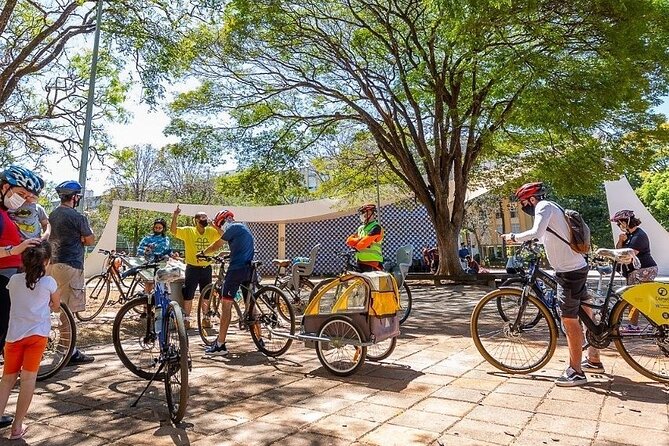
- Children can ride too: An articulated tandem passenger trailer or bike is available for children from about 4 to 10 or 12 years old, but you need to ask in advance.
Why this short ride helps explain Brasília
Brasília can be hard to read at first. Its broad avenues, separated sectors, giant public spaces, and repeated apartment blocks do not work like the compact centers of older Brazilian cities. From a car, you can see the scale. From a bicycle, you begin to understand how the pieces were meant to fit together.
This route focuses on the city’s residential scale, especially the idea of the superquadra. These large residential blocks were planned as complete units, with apartment buildings, green areas, nearby services, schools, and cultural facilities. The goal was not simply to create housing. It was to create a pattern of daily life within the larger modern city.
I like that the ride does not limit itself to Brasília’s famous monumental axis. You still see important landmarks, but much of the time is spent in parks and residential areas. That gives you a better sense of how the city functions beyond its postcard buildings.
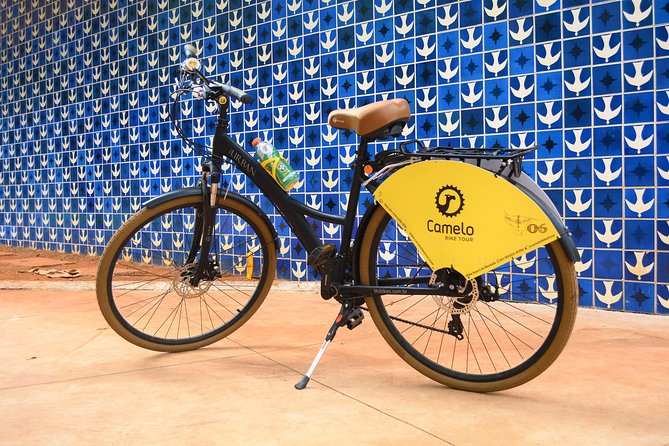
The tour lasts about three hours and returns to the starting point at Camelo Bike Tour, at SHS Quadra 06, Conjunto A, Bloco A, Loja 17, Centro Empresarial Brasil 21, in Asa Sul. It is close to public transportation, which makes the meeting point practical if you are staying elsewhere in Brasília.
A few more rides around the world worth a look
- Lion City Bike Tour of Singapore
★ 5.0 · 6,211 reviews - Big Bike tour Amsterdam – See all in 3 unforgettable hours
★ 4.7 · 4,929 reviews - 3-Hour Porto Highlights on a Electric Bike Guided Tour
★ 5.0 · 4,392 reviews
TV Tower and the first view of the city
The Torre de Televisão is the first stop after meeting the guide. You have about 10 minutes here for an explanation and photographs, with no admission fee.
This is a useful opening because the tower helps establish Brasília’s scale. The city was planned as a grand modern capital, and the tower gives you a strong reference point before the ride moves into parks and residential blocks. Your guide can also explain how the different parts of the city relate to one another.
Do not expect a long visit. Ten minutes is enough for orientation and pictures, not for a full exploration. That short stop is sensible, since the real value of the tour comes from seeing the links between the city’s districts rather than spending the entire morning at one lookout.
A nearby cultural reference is the Choro Club of Brasília. The space was inspired by the idealism of Reco do Bandolim and shaped by Oscar Niemeyer’s design. It honors the roots of Brazilian culture while supporting its continued development. Even if you are not deeply familiar with choro music, the stop adds a distinctly Brazilian note to an outing that could otherwise feel focused only on urban planning.
City Park and Burle Marx’s design
The route then reaches Parque da Cidade Sarah Kubitschek, one of the largest urban parks in the world. The planned visit lasts about 25 minutes, and admission is free.
The park changes the mood of the ride. After the formal lines and large-scale city planning near the tower, you get open space and a more relaxed setting. The park was created by landscape artist Burle Marx, whose work is central to Brasília’s visual identity.
Inside the park, the ride visits Praça Eduardo e Mônica. This square honors the song of the same name by Legião Urbana, one of Brazil’s best-known rock bands. It is a small but telling detail. Brasília is not only a capital designed by architects. It also has a strong connection to music and popular culture.
You should think of this stop as a cultural pause rather than a formal attraction with an indoor exhibit. The time is short, and the visit is free. Still, it gives you a useful way to connect the city’s public spaces with the musicians and stories that shaped its identity.
The separate 10-minute stop at Jardim Burle Marx continues that design theme. You get another look at Burle Marx’s approach to planting, form, and public space. The two park-related visits may feel brief, but together they help show that Brasília’s greenery was planned as carefully as its buildings.
SQS 308, Brasília’s model residential block
The most useful stop for understanding daily life comes at SQS 308, also called Superquadra Sul 308. The visit lasts about 45 minutes, making it the longest stop of the outing.
This block was chosen as a model for the city. Lúcio Costa designed it, Burle Marx handled its urban planning and gardens, and Banco do Brasil built it. It opened on February 19, 1962. Those details matter because SQS 308 is not just another apartment complex. It is a working example of the residential pattern planned for Brasília.
Here, you can better understand the idea behind the superquadra. The buildings, gardens, services, and shared areas were meant to support ordinary life without relying on a traditional street grid. A guide can point out how the residential block relates to nearby shopping, schools, and cultural facilities.
That practical focus is one of the tour’s strongest features. Instead of looking at Brasília only as a collection of monumental buildings, you see how the city was intended to function for residents. You may also gain a clearer sense of the tension between an ideal plan and the routines of a real neighborhood.
The nearby shopping area, school, and cinema are part of that explanation. Their presence shows the neighborhood-unit concept in concrete terms. You are not simply admiring architecture. You are looking at the services that were meant to make the superquadra livable.
The tradeoff is that this stop depends heavily on the guide’s explanation. Much of the interest lies in what the layout represents, so a strong guide makes a real difference. Duda, one of the named guides associated with this route, has been praised for taking guests through a typical superquadra and explaining Brasília’s way of life. The experience is best for you if you enjoy understanding why a place was designed a certain way, not just taking pictures of it.
Same handlebars, a completely different route:
- Small Group Guided Bike Tour of Amsterdam’s Hidden Gems
★ 5.0 · 3,936 reviews - 3-hour Complete Prague Bike Tour
★ 5.0 · 3,674 reviews - Bangkok: Temples, Canals & Local Life Bike Tour
★ 4.9 · 3,511 reviews - Lisbon: Hills, Alfama, and Mouraria Tour by Electric Bike
★ 4.8 · 3,438 reviews
Cine Brasília and Renato Russo Hall
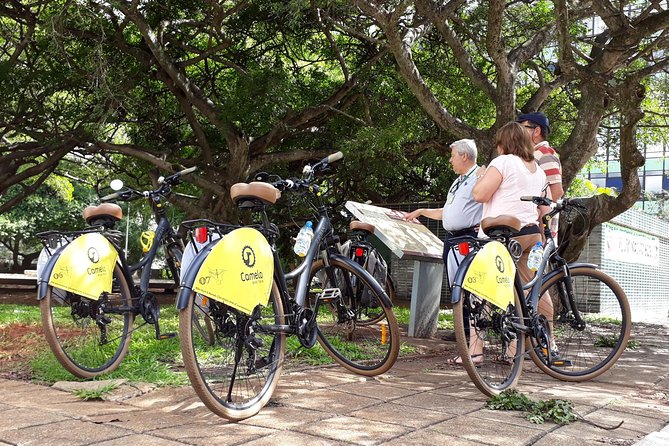
The route also takes in Cine Brasília and Renato Russo Hall. These stops broaden the picture beyond architecture.
Cine Brasília hosts the Brasília Film Festival and shows Brazilian and foreign films throughout the year. Its program can include thematic weeks, discussions, book launches, painting exhibitions, photography, posters, and projects with embassies, public schools, and universities.
That makes the cinema a useful sign of the city’s cultural life. It is not presented as a long theater visit, so do not expect a full screening or extended indoor program during the bike ride. Instead, you get context about a place that supports film, debate, and public culture.
Renato Russo Hall connects the route to one of Brasília’s most important musical figures. Along with the Praça Eduardo e Mônica, it helps show why music matters so much in the city’s identity. These references are especially valuable if you already know Legião Urbana, but the guide’s explanations can still place the band and its connection to Brasília in context.
Igrejinha Nossa Senhora de Fátima
The Igrejinha Nossa Senhora de Fátima is one of the most distinctive stops. You have about 20 minutes here, and there is no admission charge.
The church opened in June 1958 and was the first church in Brasília’s residential sector. It was built at the request of Sarah Kubitschek after her daughter recovered from an illness. That personal story gives the building a warmer, more human beginning than many of Brasília’s grand civic projects.
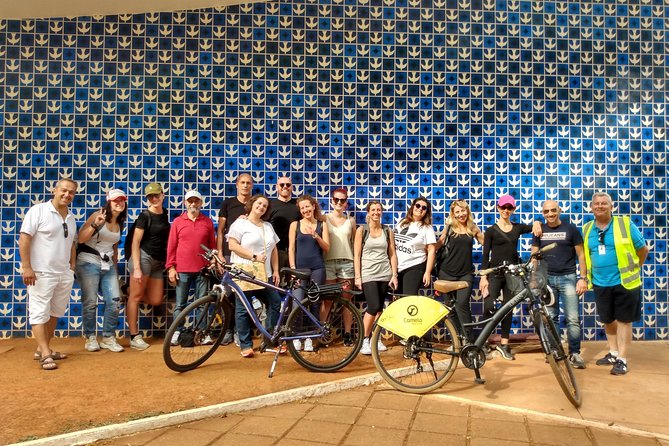
The exterior is lined with Athos Bulcão’s tiles. Their stylized figures represent the Dove of the Divine and the Star of the Nativity. The blue-and-white tile work is a key reason the church is so memorable, and it offers a sharp contrast to the broad modern forms found elsewhere in the capital.
This is a good place to slow down and look closely. The visit is short enough to fit comfortably into the cycling route, but long enough for photographs and a proper explanation. If you care about Brazilian modern art, this stop may be one of the highlights because it brings architecture and decorative design together on a small, approachable scale.
The blue light of São João Bosco Sanctuary
The final major stop is the Santuário São João Bosco, dedicated to Brasília’s patron saint, Saint John Bosco. The visit lasts about 10 minutes and is free.
This church is famous for its dramatic interior, particularly the blue light created by its stained-glass windows. The short stop works well at the end of the ride because the sanctuary offers a strong visual finish after the more analytical visit to SQS 308.
Ten minutes is not a long time, so you will want to enter ready to look around. The church is not treated as a long religious tour. Instead, it is a final architectural and visual impression, with the guide explaining why the sanctuary matters to Brasília.
The two churches also make a useful pair. The Igrejinha is intimate, colorful, and closely tied to a family story and Athos Bulcão’s tile work. São João Bosco is more dramatic and monumental. Seeing both helps you compare two very different expressions of faith in the planned capital.
What the $62.73 price gives you
At $62.73 per person, this is not the cheapest way to pedal around Brasília. The value depends on how much you want explanation along the way.
You are paying for roughly three hours of guided cycling, a planned route through several districts, access to a bicycle, and a small-group setting capped at 15 people. All listed stops have free admission, so the price is not covering entrance tickets. Its value lies in the guide’s interpretation and in the fact that the route joins places that would be harder to understand as separate visits.
I think the price makes the most sense for first-time visitors who want Brasília explained rather than simply photographed. It is also useful if you have limited time and want one organized outing that covers urban planning, public parks, music, modern art, and churches.
If you already know the city well or prefer to ride without a guide, the cost may feel less attractive. The stop times are also fairly tight, so this is not designed for lingering at every location. You are choosing structure and context over a slow, free-form ride.
Who will enjoy this bicycle tour most
I would recommend this experience to you if you enjoy modern architecture, planned cities, Brazilian music, public art, or urban design. It is particularly helpful if Brasília feels confusing from the ground and you want someone to explain how the superquadras fit into the original plan.
It also suits people who want a more active outing than a bus tour. The route includes parks and residential areas rather than only major government buildings, so you get a closer look at ordinary parts of the capital.
Families can consider it too. An articulated tandem passenger trailer or bike is available for children from roughly 4 to 10 or 12 years old, but you must request it in advance. The maximum group of 15 keeps the outing from becoming unwieldy.
You should be comfortable with outdoor cycling for about three hours. The tour requires good weather, and a poor-weather cancellation may result in a different date or a full refund. If the forecast looks uncertain, plan with some flexibility.
Booking well ahead is sensible. The tour is booked on average 41 days before departure, so last-minute availability may be limited. Confirmation is normally provided at booking, but reservations made within two days of the date may take up to 48 hours to confirm and remain subject to availability.
Should you book the Fatima Neighborhood and Church Unit Bike Tour?
Book it if you want Brasília explained through its neighborhoods, not just its monumental center. The best parts are the 45-minute visit to SQS 308, the guide’s discussion of how residents use the superquadra, Athos Bulcão’s tiles at the Igrejinha, and the striking finish at São João Bosco Sanctuary.
I would skip it if you want a long, leisurely stop at each church or a self-guided ride with no fixed pace. For most first-time visitors, though, the combination of a small group, free-entry cultural stops, and a route shaped around Brasília’s residential idea makes the $62.73 reasonable. Ask for the child trailer in advance if needed, check the weather, and reserve early if your dates are fixed.
FAQ
Where does the bike tour start?
It starts at Camelo Bike Tour, SHS Quadra 06, Conjunto A, Bloco A, Loja 17, Centro Empresarial Brasil 21, Asa Sul, Brasília.
Where does the tour end?
The activity returns to the same meeting point.
How long does the experience last?
The tour lasts approximately three hours.
What is the maximum group size?
The tour accepts a maximum of 15 participants.
Are admission tickets included?
The listed stops have free admission, so no paid entry tickets are required for them.
Can children participate?
Yes. An articulated tandem passenger trailer or bike is available for children from about 4 to 10 or 12 years old. You need to ask for it in advance.
What happens if the weather is poor?
The experience requires good weather. If it is canceled because of poor weather, you can choose a different date or receive a full refund.
Newly added rides around the world
- Pikes Peak Summit Downhill Bike Tour★ 5.0 · 51 reviews
- Garden of the Gods Original Electric e-Bike Tour★ 5.0 · 45 reviews
- Garden of the Gods Highlights and Gems Guided E-Bike eBike Tour★ 5.0 · 117 reviews
- Gold Camp Road by E-Bike★ 5.0 · 21 reviews
- Ebike Tour: Garden of the Gods★ 5.0 · 65 reviews
- Ebike 2 Hour Rental Experience in Manitou Springs, Colorado★ 5.0 · 33 reviews
- EBIKE Mountain Adventure in Colorado Springs: Gold Camp Road★ 5.0 · 16 reviews
- 3-Hour Cologne Street Art Bike Tour in Small Group with Guide★ 4.5 · 20 reviews
Tours, compared.
Big Bike tour Amsterdam – See all in 3 unforgettable hours
Read our review →
3-Hour Porto Highlights on a Electric Bike Guided Tour
Read our review →
Small Group Guided Bike Tour of Amsterdam’s Hidden Gems
Read our review →
Hills, Alfama, and Mouraria Tour by Electric Bike
Read our review →