REVIEW · TOURS
Bike Tour of the 4 Scales of Lucio
Brasília makes more sense on two wheels. This seven-hour ride links Oscar Niemeyer’s famous buildings with Lucio Costa’s urban plan, so you see both the grand capital and its everyday neighborhoods. I like the way the route combines major sights with places such as the model superquadra and the South Commercial Sector. I also like that guides such as Daniel, Romain, Larissa, and Rui have been praised for clear explanations, safe street handling, and friendly help.
The main drawback is the length. Seven hours on a bicycle is a full day, and the bike selection may not suit every rider, especially shorter adults. The tour costs $97.03 per person, lunch is extra, and you should ask in advance about the right bicycle size.
Key points before you book
- Seven hours across Brasília: This is a full city circuit, not a short monument ride.
- Four urban ideas in one route: You see Brasília through its monumental, residential, social, and park-oriented areas.
- Niemeyer and Costa together: The ride explains how Costa’s plan and Niemeyer’s buildings work as a single city.
- Everyday Brasília included: Superquadras, pharmacies, local shops, cultural centers, and commercial streets add useful context.
- Small group format: The maximum group size is 15 people, with bicycles, water, and helmets offered.
- Good value for active sightseers: The price covers a long guided route and bicycle use, but not lunch, and bicycle fit matters.
Why Brasília is best understood by bicycle
Brasília can be confusing on foot. Its monumental buildings are spread across broad avenues and formal civic spaces, while its residential blocks sit inside a carefully planned system of superquadras. A car can move you between sights, but it often leaves you looking at the city through a window.
A bicycle gives you more useful pauses. You can stop at a model residential block, pass through a park, see local commerce, and reach spaces that are awkward to connect on foot. The guide also has time to explain the city as a plan, not just point out unusual buildings.
The tour is built around Lucio Costa’s four scales: monumental, residential, gregária, and bucolic. In plain terms, that means the grand government axis, the apartment superblocks, the places where people meet and work, and the parks and open areas. This idea helps you read Brasília instead of simply collecting photographs.
The route begins at Camelo Bike Tour’s office at Brasil 21, in Asa Sul, and returns there at the end. You receive a bicycle, two 500-milliliter bottles of mineral water, and access to a helmet. Helmet use is not mandatory under Brazilian rules, but I would use one for a ride of this length.
A few more rides around the world worth a look
- Lion City Bike Tour of Singapore
★ 5.0 · 6,211 reviews - Big Bike tour Amsterdam – See all in 3 unforgettable hours
★ 4.7 · 4,929 reviews - 3-Hour Porto Highlights on a Electric Bike Guided Tour
★ 5.0 · 4,392 reviews
From the Television Tower to Clube do Choro
The first stop is the Television Tower pilotis, a useful starting point because it gives the tour an immediate sense of Brasília’s scale. You are near the central axis, where the city’s wide spaces and carefully separated functions become easier to grasp.
The stop lasts about 30 minutes and has no admission charge. Afterward, the route passes the Television Tower Craft Fair. This is a small but useful shift from official Brasília to a more informal side of the city, with local commerce replacing the polished government setting.
Clube do Choro is the next main stop. Designed by Niemeyer, it is a concert hall for about 500 people and also houses the Raphael Rabello Choro School. More than a thousand students learn instruments there, including cavaquinho, mandolin, tambourine, guitar, saxophone, flute, accordion, harmonica, violin, and viola caipira.
You have about 20 minutes here. That is enough to understand why the building matters, though not enough for a full performance. The venue also gained extra attention after Paul McCartney gave a surprise private show there on November 28, 2023. Your guide may connect the venue’s intimate scale with its musical role in the city.
The route then passes the Ulysses Guimarães Convention Center. This is not one of the main timed stops, but it helps show Brasília in use today. The center can accommodate 9,400 people at once across 54,000 square meters, with five auditoriums and 13 modular meeting rooms.
Sarah Kubitschek Park and the model superquadra
Parque da Cidade Sarah Kubitschek gives you a break from the formal government core. It is one of the largest urban parks in the world, and the tour allows about 25 minutes there.
The park is important because it shows the bucolic scale of Brasília. The city is not only ministries, domes, arches, and apartment blocks. Open recreation areas are part of the plan. The route also passes Renato Russo Hall, a cultural venue named for the Brasília-born rock musician.
The most useful residential stop is SQS 308, known as the model superquadra. Lucio Costa designed the court, Burle Marx handled the urbanism and landscaping, and Banco do Brasil built it. It opened on February 19, 1962.
You have about 45 minutes here, one of the longest stops of the day. Use that time to look beyond the apartment facades. The superquadra includes housing projections, local shops, schools, and leisure areas. The design aims to place daily needs inside a larger green residential setting rather than arranging the city around traditional streets.
This is one of the tour’s strongest sections because it turns an abstract planning idea into something you can walk or cycle through. You can compare the intended model with the way Brasília functions today.
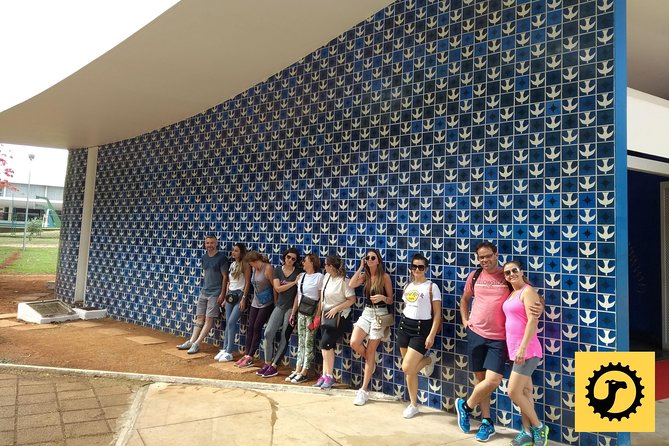
The nearby Igrejinha Nossa Senhora de Fátima is another worthwhile pause. Built in 1958 at Dona Sarah Kubitschek’s request, it was the first church in the residential sector. Athos Bulcão’s exterior tiles show a dove and a star in simplified forms.
The church is small compared with Brasília’s cathedral, which is exactly why it matters. It feels tied to neighborhood life rather than national ceremony. The visit lasts about 20 minutes.
The tour also stops at Superquadra Sul 302 for about 15 minutes. It is not the original model block, but its arrangement shows the same residential scale. Seeing both blocks helps you compare a specific designed example with the wider system.
Itamaraty, the Sanctuary, and Brasília’s modernist interiors
Palácio Itamaraty, also called the Palace of the Arches, is home to Brazil’s Ministry of Foreign Affairs and is one of Niemeyer’s best-known works. The scheduled stop lasts about 10 minutes.
Even a short visit is useful here because the building shows how Brasília’s official architecture uses curves, water, open space, and strong concrete forms. The tour does not include an admission ticket, and the schedule does not promise an interior visit, so treat this as an exterior architectural stop unless your guide tells you otherwise.
The Sanctuary of Saint John Bosco follows, with about 15 minutes. Dedicated to Brasília’s patron saint, the sanctuary is known for its interior atmosphere and blue-toned glass. The stop adds a religious building to a route otherwise filled with government and cultural architecture.
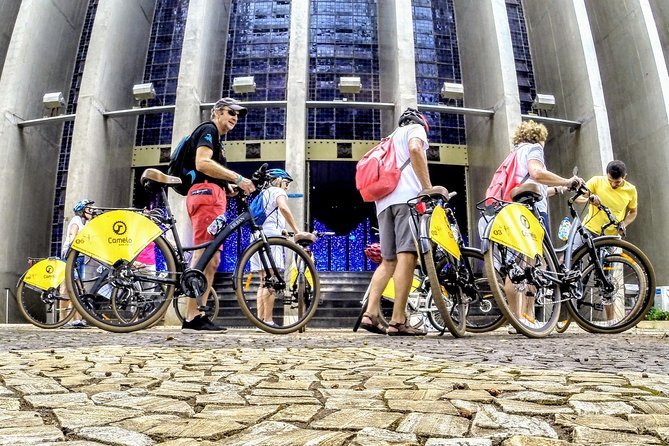
The Metropolitan Cathedral comes next, with about 15 minutes. Designed by Niemeyer, it is one of Brasília’s signature modern buildings. Its curved structure and sculptural entrance make it easy to recognize, but the value of seeing it with a guide is understanding how it fits into the city’s larger design.
The route then passes Rua das Farmácias, a commercial street dominated by pharmacies because of its proximity to the South Medical and Hospital Sector. This is a quick but telling detail. Brasília’s plan separates functions, yet everyday commerce grows around the needs of nearby institutions.
Same handlebars, a completely different route:
- Small Group Guided Bike Tour of Amsterdam’s Hidden Gems
★ 5.0 · 3,936 reviews - 3-hour Complete Prague Bike Tour
★ 5.0 · 3,674 reviews - Bangkok: Temples, Canals & Local Life Bike Tour
★ 4.9 · 3,511 reviews - Lisbon: Hills, Alfama, and Mouraria Tour by Electric Bike
★ 4.8 · 3,438 reviews
The social scale in the South Commercial Sector
Praça do Povo, in the South Commercial Sector, was renovated in 2021. The project received a regional award from the Instituto de Arquitetos do Brasil for urbanism, planning, and cities.
The square now supports skateboarding, shows, and kiosks. That mix makes it a good example of how a planned public space can change over time. It is not only a formal plaza to photograph. It is intended for use.
Museu Nacional da República gets a brief five-minute stop. Designed by Niemeyer as part of Brasília’s original cultural complex, the building belongs to the city’s monumental core. The short timing means you should not expect a museum visit, but the exterior is an important piece of the route.
You then spend about 30 minutes in Setor Comercial Sul. This is one of the most revealing sections for anyone who wants more than the famous monuments. On weekdays, it carries heavy pedestrian movement because of its services, institutions, connection to the bus station, and proximity to the Esplanade of Ministries.
Here you see the gregária scale, the part of the city meant for collective interaction. The area includes buildings associated with architects such as Lelé and Niemeyer, as well as newer public-space projects. It also gives you a look at Brasília’s cultural mix, which can be missed if you stay only in the monumental axis.
The route passes the first Sarah Hospital, a rehabilitation center focused on locomotion and orthopedic conditions. Architect João da Gama Filgueiras Lima, known as Lelé, designed the hospital approach around natural light, ventilation, flexible interiors, and large open areas.
Lelé worked with Niemeyer and Costa and taught at the University of Brasília. His work focused on construction methods and practical building systems. That makes the Sarah Hospital a useful counterpoint to Niemeyer’s sculptural public buildings. It shows that Brasília’s architectural story includes careful problem-solving, not only dramatic forms.
Three Powers Square and the heart of the capital

Praça dos Três Poderes is the civic center of the route. Created by Lucio Costa and designed by Oscar Niemeyer, it opened with Brasília on April 21, 1960.
The square brings together the main branches of Brazil’s federal government. The 20-minute stop gives you time to take in the open space, the surrounding buildings, and the deliberate placement of political power at the end of the monumental axis.
Espaço Lucio Costa is below ground and houses a model of Brasília as well as a tactile model of the Plano Piloto. Its 15-minute stop may be the best place to understand the city as a whole. The models show how the wings, central axis, residential blocks, and civic areas relate to one another.
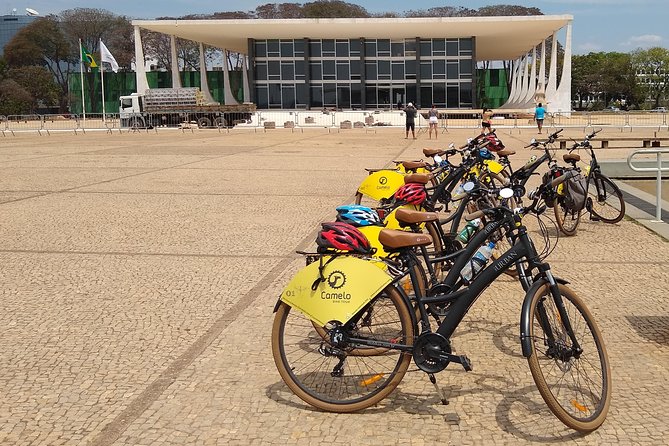
You also pass Brasília Classic Mall and stop briefly at the Supreme Federal Court. The court occupies one vertex of Praça dos Três Poderes, opposite the Planalto Palace, and was designed by Niemeyer with an original concept by Costa.
The route includes the Pantheon of the Fatherland, with about five minutes, and passes the National Congress and the Esplanade of Ministries. These are quick viewing points rather than extended visits. The Congress is the main visual marker at the head of the Esplanade, while the ministries form the broad governmental axis that gives central Brasília its ordered, monumental character.
The tour ends its sightseeing loop at Burle Marx Garden, with about 10 minutes, before returning to the starting point. The garden brings the route back to planting, open space, and the softer side of the city plan.
What the seven-hour schedule feels like
Seven hours sounds long because it is long. The schedule includes many short stops, but it also includes a 45-minute visit at the model superquadra and a 30-minute period in the South Commercial Sector. You are not simply pedaling past buildings without pause.
The exact cycling distance is not provided, so I would not book this based on a guessed mileage. Instead, think of it as a full-day active sightseeing program. If you are comfortable spending most of a day on a bicycle, the pace gives you a broad view of Brasília. If you prefer slow museum visits or long meals, this may feel rushed.
Lunch is not included. Plan for that cost and ask the operator how the meal break is handled on your date, since the published schedule lists the tour at about seven hours but does not give a dedicated lunch stop.
The group maximum is 15 people. That is small enough for guide interaction, though the experience can still feel different depending on the group’s cycling pace and bicycle needs.
Bicycle fit, guides, and family details
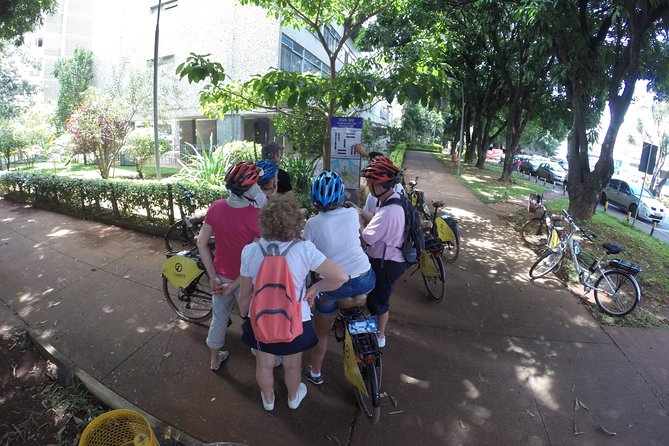
Bicycle fit deserves attention before you pay. One account praised the time spent checking the fit, but also noted that finding suitable bikes was difficult for two shorter women. The operator has said it is working on bicycle upgrades, but you should still give your height or special requirements in advance.
Guide quality is a major strength. Daniel has been praised for directing crossings, managing traffic lights, helping with photographs, and explaining the city in an entertaining way. Romain has been noted for strong explanations of architecture and history, while Larissa and Rui have also been praised for attentive, pleasant guiding.
Your actual guide will depend on the date. The important point is that the tour needs more than someone who knows the route. Brasília’s value comes from connecting buildings, planning, and daily life, so clear explanation makes a real difference.
Children from about four to 10 or 12 can use an articulated tandem passenger trailer or bike, but you must ask in advance. Most people can participate according to the activity information, yet the seven-hour duration means you should make an honest assessment of your child’s comfort and cycling ability.
Is $97.03 good value?
At $97.03 per person, this is not a cheap way to see Brasília. It is a substantial guided experience, though, and the cost includes bicycle use, two bottles of water, a helmet option, and a route lasting about seven hours.
I consider the price reasonable for visitors who want a structured overview of Brasília’s architecture and planning. You would need several shorter outings to connect the Television Tower, superquadras, cathedral, commercial sectors, cultural buildings, and government core on your own.
The value is weaker if you mainly want quick photographs of Niemeyer’s famous buildings. A shorter car-based city tour would probably suit that goal better. This ride earns its price through context, local streets, and the chance to understand how the planned city works beyond its postcard buildings.
The experience has a five-star rating from 49 reviews, with 100 percent recommending it. That is a strong signal, but the practical warnings still matter: inspect the bicycle, request the right size, and prepare for a long day.
Should you book the 4 Scales of Lucio tour?
Book it if you want Brasília explained as a city, not just displayed as a collection of modern buildings. I would choose it for an active first visit, especially if you care about architecture, urban planning, public spaces, and the contrast between monumental Brasília and ordinary residential life.
Think twice if you dislike long bicycle rides, need a guaranteed premium bike, or want extended indoor visits at museums and government buildings. Ask about bicycle fit before booking, bring suitable clothing for a full day outdoors, and budget separately for lunch.
For the right rider, this is one of the better ways to make sense of Brasília. You see the grand axis, the model superquadra, working commercial areas, cultural venues, parks, and places of worship in one connected route.
FAQ
How long does the bike tour last?
The tour lasts approximately seven hours.
How much does the tour cost?
The listed price is $97.03 per person.
Where does the tour begin and end?
It begins at Camelo Bike Tour, SHS Quadra 06 Conjunto A, Bloco A, Loja 17, Centro Empresarial Brasil 21, Asa Sul, Brasília. It ends back at the same meeting point.
Are bicycles included?
Yes. Bicycle use is included in the tour price.
Is a helmet included?
Helmets are available. Helmet use is not mandatory in Brazil.
Is lunch included?
No. Lunch at the restaurant is not included.
Can children join the tour?
Children from about four to 10 or 12 years old can use an articulated tandem passenger trailer or bike. You need to ask about this in advance.
What is the maximum group size?
The tour has a maximum of 15 participants.
Newly added rides around the world
- Half-Day Lanna Countryside Cycling Tour in Chiang Mai★ 4.5 · 24 reviews
- Full-day E-bike Countryside and Nam Phrae (flat-hilly, GUIDED)★ 5.0 · 11 reviews
- Full-Day Hike and Bike Tour from Chiang Mai★ 5.0 · 14 reviews
- Experience The Real Chiang Mai by Bike★ 4.5 · 36 reviews
- FIELDS OF GOLD Mountain Biking Tour Chiang Mai★ 5.0 · 18 reviews
- Half-Day Colors of Chiang Mai Biking Tour★ 5.0 · 105 reviews
- Chiang Mai City Culture Half-Day Cycling Tour★ 4.5 · 15 reviews
- Chiang Mai Night Bike Tour★ 5.0 · 69 reviews
Tours, compared.
Big Bike tour Amsterdam – See all in 3 unforgettable hours
Read our review →
3-Hour Porto Highlights on a Electric Bike Guided Tour
Read our review →
Small Group Guided Bike Tour of Amsterdam’s Hidden Gems
Read our review →
Hills, Alfama, and Mouraria Tour by Electric Bike
Read our review →