
REVIEW · AMSTERDAM BIKE TOURS
Amsterdam Anne Frank and Jewish History E Bike Tour
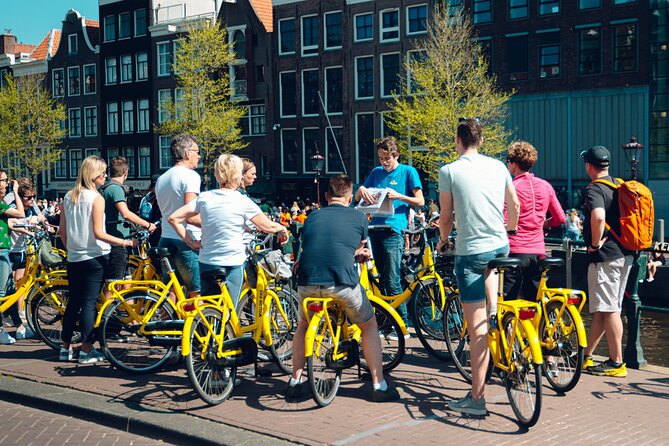
Amsterdam’s wartime story rides on two wheels. This three-hour e-bike tour links Anne Frank’s childhood neighborhood with Amsterdam’s Jewish Quarter, the National Holocaust Names Monument, and the original Anne Frank House. I like the route’s balance of major landmarks and less familiar places, and I like that the e-bike makes a long city ride manageable. The main drawback is that entry to the Anne Frank House and Portuguese Synagogue costs extra.
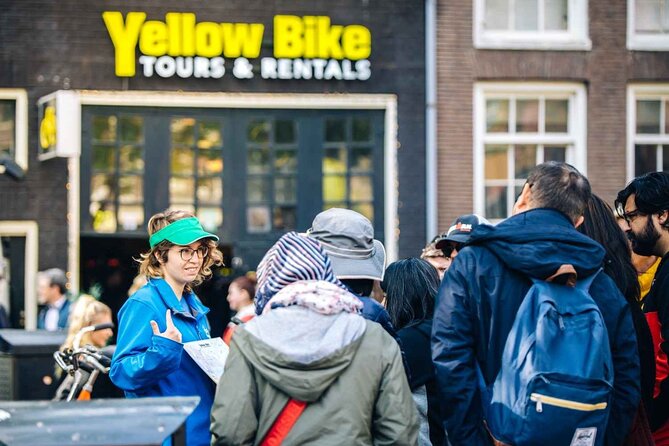
You meet at Nieuwezijds Kolk at 2 p.m. and return there at the end. Guides such as Willem, Lucas, Ruben, and Wilhelm have been praised for clear storytelling, humor, warmth, and care with difficult material. Still, this is a serious subject, and the cycling format means you should be comfortable riding in city traffic and spending much of the afternoon outdoors.
Key points to know before you book
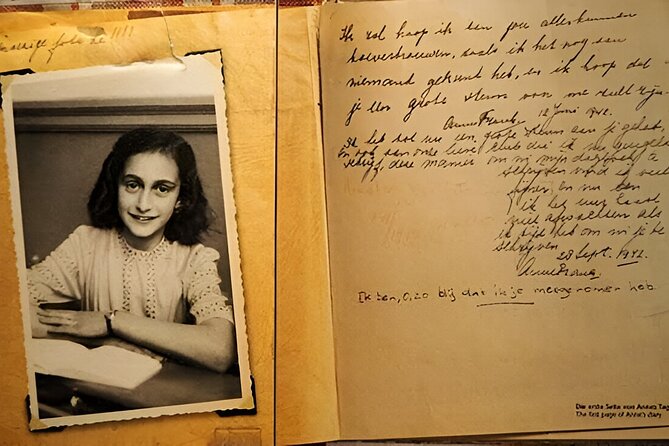
- Anne Frank’s Amsterdam beyond the famous house: Visit her former home, school, neighborhood square, and the bookstore where she bought her diary.
- A moving Holocaust memorial stop: Allow time at the National Holocaust Names Monument, where Jewish, Sinti, and Roma victims are remembered by name.
- A practical three-hour route: The e-bike connects widely scattered sites that would take much longer to cover on foot.
- Strong guide-led storytelling: Willem, Lucas, Ruben, and Wilhelm have all been praised for enthusiasm, clarity, and a welcoming manner.
- Museum admission is separate: The tour visits the Anne Frank House from outside, but does not include entry.
- Important bike restriction: Participants must be at least 152 centimeters, or about 5 feet, tall.
Why this e-bike route works for Amsterdam
Amsterdam is easy to explore by bike, but its Jewish history and Anne Frank sites are spread across several districts. This tour solves that problem by using an e-bike to connect central Amsterdam with the former Jewish Quarter and the southern neighborhood where Anne Frank spent her childhood.
You are not simply riding from one postcard view to another. The route moves between places tied to Jewish life, wartime resistance, deportation, memory, and Anne Frank’s family. That gives the afternoon a clear shape. You begin with the city’s older center, move into Jewish Amsterdam, pause at memorials, and then follow Anne Frank’s personal story through the places connected with her early life.
The e-bike matters here. The listed stops include many short visits of 10 to 30 minutes, but the distances between them add up. A standard bicycle might suit strong riders, while the electric assistance makes the route more approachable for most people who can ride comfortably. You still need to pay attention to Amsterdam traffic, though. An e-bike is help, not a substitute for basic cycling confidence.
The price is $63.22 per person. I consider that fair if you want transport, a guide, and a connected route in one package. You are paying for the structure and interpretation as much as the bike itself. It is less attractive if you mainly want free time at each site or plan to enter museums along the way, since admission fees are not included.
More E-Bike Tours in Amsterdam
- Amsterdam: Windmill, Cheese, and Countryside E-Bike Tour
★ 4.5 · 1,308 reviews - Amsterdam Highlights Bike or E-Bike Tour
★ 5.0 · 1,171 reviews - Cheese, Canals & Windmill Countryside E-Bike Tour Amsterdam
★ 5.0 · 501 reviews
Starting at Nieuwezijds Kolk with Amsterdam’s oldest stories
The meeting point is Nieuwezijds Kolk 29, near public transportation. The tour begins here with an introduction to Anne Frank and Amsterdam’s Jewish past, before setting off from what is described as perhaps the oldest spot in Amsterdam.
That opening is useful because it gives the rest of the ride a starting point in the city’s long development. Instead of beginning immediately with the Second World War, the guide first places Jewish life and Anne Frank’s story within Amsterdam itself.
The stop lasts about 20 minutes and has no admission charge. Since the activity ends back at the same meeting point, you do not need to plan a separate return journey across town.
Nieuwmarkt and the beginning of the Jewish Quarter
After a short ride, you stop at Nieuwmarkt, at the start of the Jewish Quarter. Here the guide covers Jewish life in Amsterdam and the events of the Second World War.
This is one of the more important transitions on the route. Nieuwmarkt connects the everyday city you see today with the neighborhoods where Jewish families lived, worked, worshiped, and built community. A guide can point out how the district fits together in a way that a quick walk through Amsterdam’s center might not.
The stop lasts roughly 20 minutes. You should expect to listen rather than tour an indoor museum. That keeps the tour moving, but it also means the amount of detail depends on the guide and the questions asked by the group.
The Portuguese Synagogue and Waterlooplein
The Portuguese Synagogue is viewed from outside for about 10 minutes. It is described as Amsterdam’s biggest synagogue, and its exterior gives you a visible marker of the city’s Jewish heritage.
Because entrance is not included, you should not expect an interior visit during this tour. If seeing the synagogue inside is important to you, you will need to arrange a separate admission. The same applies to several other sites on the route: this is primarily an outdoor history tour, not a museum pass.
The next stop takes you through the Jewish Cultural District and around Waterlooplein market. The visit lasts about 10 minutes. Waterlooplein adds an everyday city setting to the route, placing historic Jewish Amsterdam beside a working market area rather than treating the past as something sealed away from modern life.
More E-Bike Tours in the Netherlands
- Escape Amsterdam: E-Bike to Zaanse Schans Windmills & Zaandam
★ 5.0 · 446 reviews - Amsterdam: 3h E-Bike Tour with break
★ 4.6 · 230 reviews - Amsterdam: Zaanse Schans Windmills & Zaandam E-Bike Tour
★ 4.9 · 162 reviews - Amsterdam: E-Bike Sightseeing Tour
★ 4.7 · 99 reviews
The Dokwerker and the February Strike
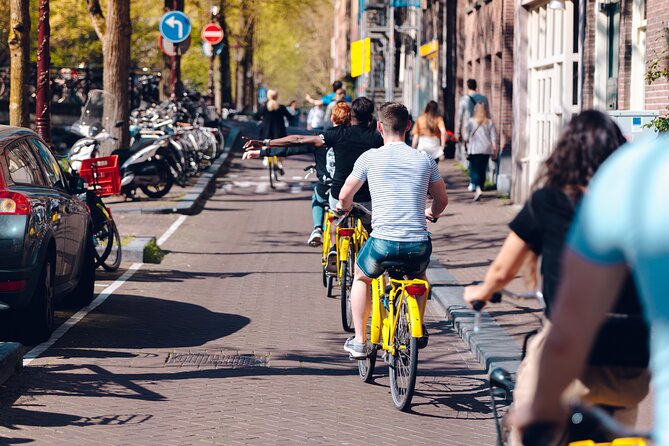
At the Dokwerker, the guide explains the February Strike during the Second World War. This is a short, approximately 10-minute stop, but it carries considerable weight.
The value here is the connection between a physical monument and a specific act of resistance. Rather than presenting the war as a string of dates, the guide uses the Dokwerker to explain how people in Amsterdam responded to the persecution of Jewish residents.
This kind of stop is one reason the guided format is worthwhile. Without context, a sculpture can be easy to pass. With the story attached, you understand why it matters and why it belongs on this route.
The National Holocaust Names Monument
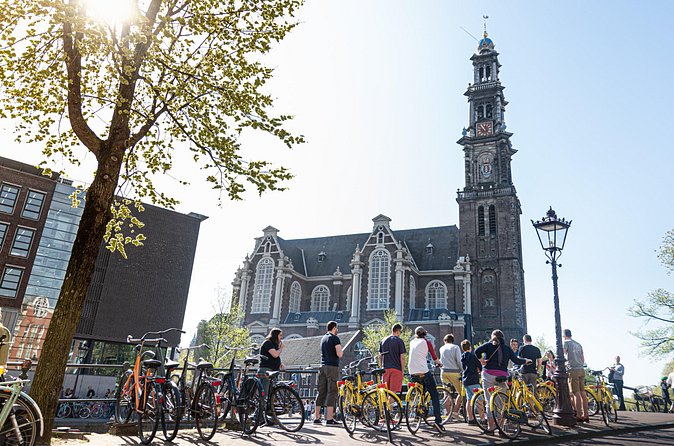
The longest stop is the National Holocaust Names Monument, with about 30 minutes to walk around, listen, and take in the memorial. The monument commemorates Jewish, Sinti, and Roma people murdered during the Second World War.
The inclusion of names gives this part of the tour a different feel from the earlier city stops. You are not only hearing about policy, neighborhoods, or resistance. You are facing a memorial built around individual people.
I would treat this as the emotional center of the afternoon. The schedule allows more time here than at most other stops, which is appropriate. You may want to move quietly and give yourself room to process what you hear. This is not a light sightseeing excursion, and families should consider how children or younger teenagers will respond to the subject.
Leendert Pop and the power of one personal story
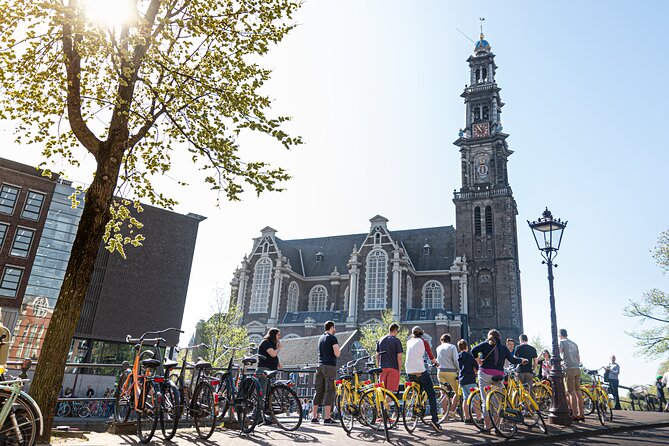
At the Leendert Pop stop, the guide tells the story of an elderly Jewish Amsterdammer during the Second World War. The visit lasts about 10 minutes.
A personal story can make a broad historical subject easier to grasp. The route already covers institutions, monuments, and neighborhoods. This stop brings attention back to one person’s experience, helping you connect the large events of the war with ordinary life in Amsterdam.
The supplied details do not explain whether the stop includes a statue, building, or other specific feature, so you should think of it mainly as a guide-led storytelling point. Its success will depend heavily on the guide’s ability to tell the story clearly and respectfully.
Berlagebrug and wartime Amsterdam
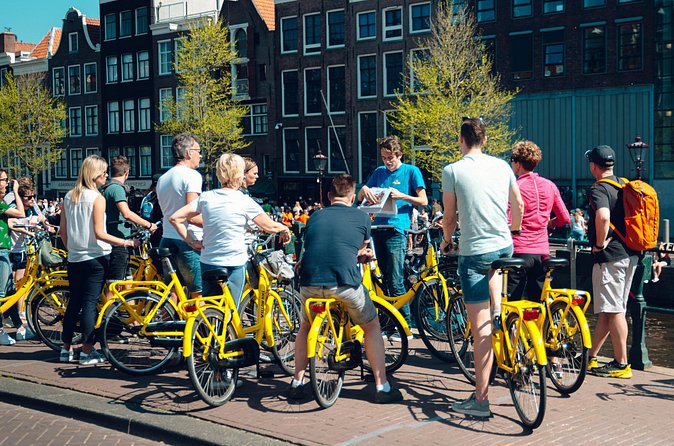
The tour then reaches Berlagebrug, where the guide explains the bridge’s history during the Second World War. This is another brief stop of about 10 minutes.
A bridge may not look like an obvious Anne Frank site, which is part of the route’s appeal. The tour uses the city itself as a historical setting. You are shown how ordinary infrastructure can hold wartime meaning, even when there is no grand museum or famous facade to announce it.
This is also a useful reminder that the experience is not limited to Anne Frank biography. The wider subject is Jewish Amsterdam during a period of persecution and war.
Jimmink bookstore and the diary
At Bookstore Jimmink, you visit the shop where Anne Frank bought her famous diary. The stop lasts around 10 minutes.
This is one of the route’s most personal details. The diary is known around the world, but the bookstore provides a direct link to a real moment before Anne went into hiding. It brings the story back to a young girl choosing a notebook in an ordinary Amsterdam setting.
You will not be entering the Anne Frank House at this point, and the tour does not include museum admission. Still, this small stop adds something the famous house alone cannot provide: a glimpse of Anne’s life before the hiding period became the center of her story.
Anne Frank’s sculpture, home, and neighborhood
The route continues to the sculpture of Anne Frank on the square where she grew up as a Jewish girl before and during part of the Second World War. You spend about 10 minutes here.
Next comes Merwedeplein, where you see the house in which Anne grew up before going into hiding. Another 10-minute stop brings you to the 6th Montessori School Anne Frank, the school she attended.
Taken together, these stops show Anne as a child and student, not only as the author of a wartime diary. That broader view is one of the strongest features of the tour. You see the places linked with family life, education, and neighborhood routines before the German occupation changed everything.
The visits are short, so do not expect long periods inside the buildings. The value comes from connecting the locations with the guide’s explanation. If you want to linger, photograph every detail, or explore the area at your own pace, the schedule may feel brisk.
Finishing at the Anne Frank House
The final stop is the Anne Frank House, where the guide explains the history of Anne and her family in hiding during the Second World War. You spend about 20 minutes near the original house.
This is an important distinction: the tour reaches the Anne Frank House, but admission is not included. You should not book this experience assuming it gives you entry to the museum. If you want to go inside, arrange a separate ticket and allow extra time beyond the three-hour ride.
Even from outside, ending here gives the route a clear conclusion. The earlier stops have shown Anne’s childhood, her school, her neighborhood, and the diary. The final explanation brings those details into the story of the family’s time in hiding.
The tour then returns to Nieuwezijds Kolk. That makes it easier to continue with dinner, another central Amsterdam activity, or public transportation from a familiar point.
The guides make or break the experience
The strongest praise has focused on the guides. Willem is described as enthusiastic and engaging, with a strong command of Amsterdam and Jewish history. Lucas has been praised for humor, communication, flexibility, and giving people time for questions.
Ruben has led a family ride described as friendly and informative. Wilhelm was singled out for making an adult and grandchild feel comfortable and eager to learn. These comments point to a clear strength: the tour depends on guides who can handle heavy subjects without becoming cold or overly formal.
Guide quality can vary from one departure to another, but the named guides have shown several useful traits. They explain clearly, answer questions, and create a welcoming tone. One particularly strong account praised the guide for telling stories that made the years before and during the war easier to understand.
Who should book this tour?
I would recommend it to you if you want a guided introduction to Amsterdam’s Jewish history and Anne Frank’s life, especially if you prefer seeing several neighborhoods rather than spending three hours in one museum.
It is also a good match for families with older children or teenagers who can manage city cycling and engage with serious historical material. The e-bike reduces the physical effort, while the short stops keep the route changing.
You should think twice if you dislike cycling, find city traffic stressful, or want a quiet museum experience. The tour has a maximum capacity of 99 people, although the actual group size is not stated, so you should not assume a small private outing. You also need to be at least 152 centimeters tall.
The tour is offered in English, uses a mobile ticket, and confirmation is provided at booking. Food and drinks are not included. Free cancellation is available until 24 hours before the 2 p.m. start time. If the minimum number of participants is not reached, the operator may offer another date or experience, or a full refund.
Should you book the Anne Frank e-bike tour?
Book it if you want a thoughtful, active way to connect Amsterdam’s Jewish Quarter, wartime memorials, and Anne Frank’s personal landmarks. The best parts are the route design, the visit to the National Holocaust Names Monument, and the chance to see Anne’s former home, school, neighborhood, and bookstore in one afternoon.
I would not book it as a replacement for the Anne Frank House. Admission is separate, and the exterior stop is only one part of a wider city ride. But as a historical introduction, the $63.22 price is reasonable: you get an e-bike, a guide, and access to places that are scattered across Amsterdam and easy to miss on your own.
FAQ
How long does the Anne Frank and Jewish History E-Bike Tour last?
The tour lasts approximately three hours.
What time does the tour start?
The tour starts at 2 p.m.
Where does the tour begin?
You meet at Nieuwezijds Kolk 29, 1012 PV Amsterdam, Netherlands.
Where does the tour end?
The tour ends back at the meeting point at Nieuwezijds Kolk.
Is entry to the Anne Frank House included?
No. The tour visits the Anne Frank House from outside, but entrance fees are not included.
Is entry to the Portuguese Synagogue included?
No. The Portuguese Synagogue is viewed from outside, and its entrance fee is not included.
Who can participate in the bike tour?
Most people can participate, but riders must be at least 152 centimeters, or about 5 feet, tall. The tour is offered in English and includes use of an e-bike.
More History Tours in Amsterdam
- Historic Athens: Small Group Electric Bike Tour
★ 4.9 · 966 reviews - Bordeaux: Historic Center & Chartrons District Bike Tour
★ 4.8 · 709 reviews - Intramuros, Manila: Historical Bamboo Bike Tour
★ 4.8 · 583 reviews - Historic Bike Tour in Tucson
★ 5.0 · 553 reviews
More Historic Bike Tours in Amsterdam
- Historical Singapore Bike Tour on Full-Sized Bicycles
★ 5.0 · 1,421 reviews - Barcelona: 2.5-Hour Bike or E-Bike Historical Tour
★ 4.5 · 1,262 reviews - Asheville Historic Downtown Guided Electric Bike Tour with Scenic Views
★ 5.0 · 1,234 reviews - Krakow: Bike Tour of Old Town, Jewish Quarter and the Ghetto
★ 4.9 · 1,155 reviews
Newly added rides around Amsterdam
- Amsterdam E Bike Tour to the Windmills of Zaanse Schans★ 5.0 · 65 reviews
- Private Amsterdam City Highlights Bike Tour (PRIVATE GUIDE)★ 5.0 · 28 reviews
- Daily group bike tour in Spanish.★ 5.0 · 60 reviews
- Amsterdam 3 hrs Bike Tour – live guide En/Fr/De/Nl/Sp★ 4.5 · 138 reviews
- Bill’s Bike Tour Amsterdam – Culture, Liberalism & Tolerance★ 5.0 · 28 reviews
- Zaanse Schans Windmills E Bike Day Trip from Amsterdam★ 5.0 · 15 reviews
- Explore Amsterdam by Bike in the Company of a French Local Guide★ 4.5 · 31 reviews
- Amsterdam’s Hidden Gems and Street Art Bike Tour★ 5.0 · 65 reviews
Amsterdam Bike Tours, compared.
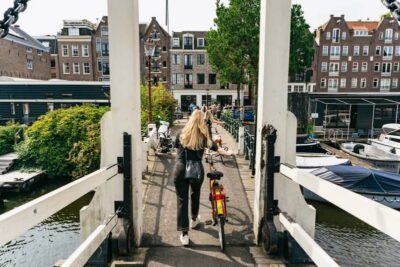
Big Bike tour Amsterdam – See all in 3 unforgettable hours
Read our review →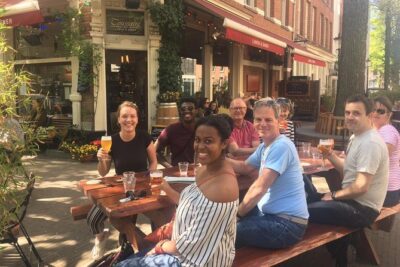
Small Group Guided Bike Tour of Amsterdam’s Hidden Gems
Read our review →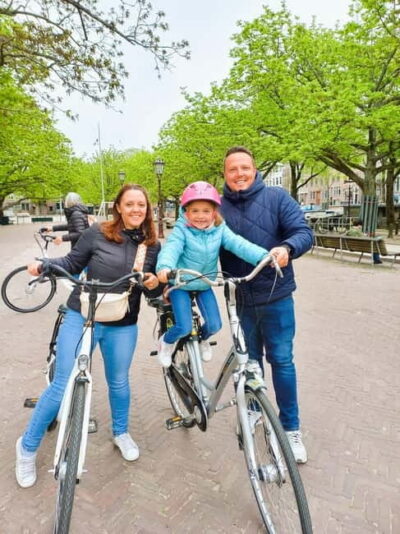
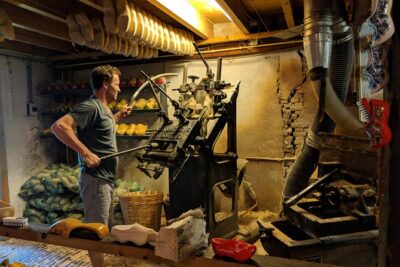
Countryside Bike Tour from Amsterdam: Cheese, Clogs & a Windmill
Read our review →
Windmill, Cheese, and Countryside E-Bike Tour
Read our review →
Browse the lists this tour appears in