
REVIEW · BERLIN BIKE TOURS
Alternative Berlin Bike Tour – Off the Beaten Tracks in Small Groups
Berlin has more than postcard sights. This 3.5-hour ride takes you through Friedrichshain and Kreuzberg, where street art, Soviet-era housing, old Wall sites, parks, and club culture tell a less polished but more revealing story. I like the route’s mix of history and everyday Berlin, and I like that bikes and helmets are included. The main drawback is traffic, which can feel tense for younger riders or anyone unused to city cycling.
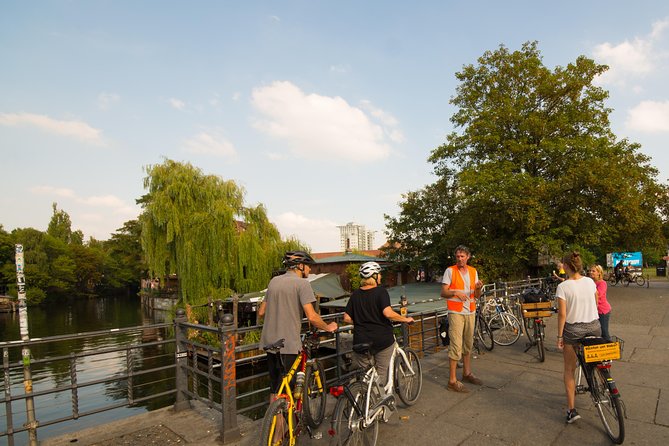
You start at 3 p.m. at Berlin on Bike in the Kulturbrauerei complex and return there after covering a good stretch of the city. Guides such as Anna, Paul, Marcus, George W., Lauren, and Maria have been praised for personal stories and strong local insight, but the guide on your date may differ. The group is capped at 14, a useful size for keeping the ride moving without losing the human touch.
Why this Berlin ride is worth your afternoon
- Kulturbrauerei sets the scene: Begin among preserved 19th-century brewery buildings, courtyards, and cultural spaces.
- Karl-Marx-Allee reveals East Berlin: Ride past monumental Socialist Classicist apartment blocks and towers shaped by Soviet-era planning.
- RAW Tempel and Görlitzer Park show present-day Berlin: Expect art projects, clubs, markets, political expression, and a few rough edges.
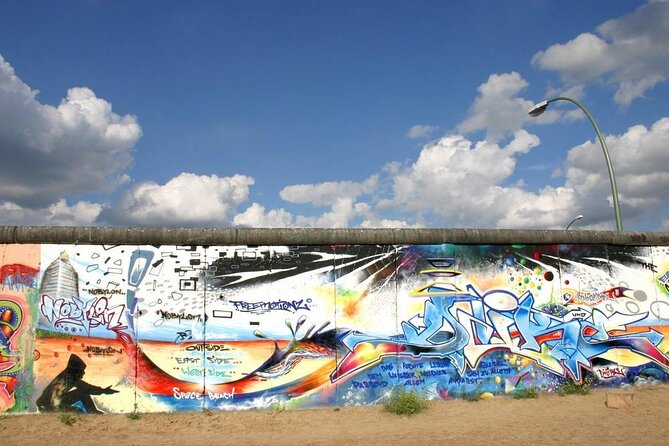
- The Berlin Wall appears in a wider context: East Side Gallery and the Oberbaum Bridge connect Cold War history with today’s creative districts.
- Personal guiding is a major strength: Guides including Anna and Marcus have been praised for stories that make the neighborhoods feel lived-in.
- The ride is flat but not effortless: Berlin makes cycling fairly manageable, yet three and a half hours on city streets calls for moderate fitness.
Starting among breweries at Kulturbrauerei
The meeting point is Berlin on Bike, Knaackstraße 97, at the Kulturbrauerei in Prenzlauer Berg. This is both the bike depot and the place where you finish, so you do not need to arrange a second pickup or figure out how to return across town.
Kulturbrauerei is a striking place to begin. The 25,000-square-meter complex was built as a brewery ensemble in the late 19th century and has been protected since 1974. Its brick buildings and courtyards now hold cultural uses, giving you an early clue about the tour’s approach: Berlin’s past is rarely sealed behind glass. Old industrial structures often become art, music, food, or social spaces.
The first stop is brief, listed at about five minutes, so do not expect a full architectural tour. Instead, use it as a visual introduction before the group gets moving. Your guide will likely spend more time explaining how the city changes from one district to the next than reciting dates.
The start time is 3 p.m. That gives you a useful afternoon outing, though the ride may run into busier street conditions than an early morning tour. Dress for the forecast. The tour operates in all weather conditions unless poor weather leads the operator to cancel it.
A few more rides around Berlin worth a look
- Berlin: Sights and Highlights Bike Tour with a Local Guide
★ 4.8 · 2,698 reviews - Berlin Highlights 3-Hour Bike Tour
★ 5.0 · 948 reviews - Berlin City Bike Tour with Beer Garden Stop
★ 5.0 · 917 reviews
Volkspark Friedrichshain and the city’s breathing room
From the depot, the route reaches Volkspark Friedrichshain, Berlin’s first municipal green area, created in 1846. The park gives the ride a needed change of pace after urban streets and dense apartment blocks.
I like this part because it helps you see Berlin as a city with room to pause. Parks are not just decorative stops here. They are part of daily life, places where neighborhoods meet, exercise, relax, and escape the hard surfaces of the inner city.
The exact amount of time spent at each point can vary, but the tour is built around short stops and continued riding rather than long admissions or indoor visits. That matters if you prefer to keep moving. It also means you should not book this as a formal park tour or a museum experience. The value is in the connections between places.
Karl-Marx-Allee and the scale of East Berlin
Karl-Marx-Allee is one of the route’s most useful history lessons. The broad avenue is lined with apartment blocks and towers influenced by Socialist Classicism and the Prussian Schinkel school. The buildings are more than backdrops for photographs. They show how East Berlin wanted to present power, order, housing, and modern life.
The grand scale can be surprising. You are not simply looking at one monument. You are riding through a planned urban statement, where architecture was intended to shape public identity. A guide who knows the area can help you read the buildings instead of reducing them to an old political curiosity.
This is also where the bicycle format earns its keep. On foot, the avenue can feel spread out. By bike, you can cover more ground and compare the blocks, towers, streets, and surrounding neighborhoods without spending the whole afternoon walking between them.
One of the strongest qualities of this tour is its balance between formal history and current life. You may hear about the German Democratic Republic, then move on to street art, clubs, or local disputes. Berlin’s story does not sit neatly in separate chapters, and the ride makes that clear.
RAW Tempel and Friedrichshain’s rougher creative edge
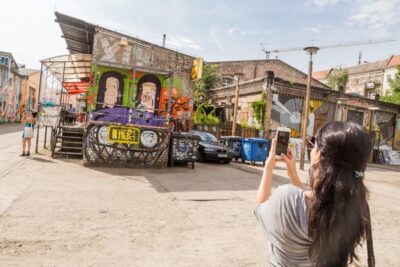
RAW Tempel is one of the most distinctive stops. The former industrial site now provides space for intercultural projects, exhibitions, markets, clubs, and bars. It is the kind of place that can be difficult to understand from a standard sightseeing route because its appeal depends on atmosphere, changing uses, and the people who make something happen there.
This is a good point to keep your expectations realistic. RAW is not a polished cultural center with a single grand attraction. It is more informal and changeable. You might find art activity, nightlife connections, and a strong sense of Berlin’s independent scene, but the appeal is precisely that it feels less managed than the city’s major sights.
Several guides have been praised for making these places meaningful through personal experience. Anna, described as closely connected to Berlin’s alternative scene, has been especially well received for explaining art crews, neighborhood life, and cultural change. Marcus has also been praised for using personal stories to bring the city to life. Your guide will vary, but the tour clearly depends on this human layer rather than on landmarks alone.
The route’s discussion of techno clubs, independent shops, casual bars, and political graffiti helps explain why Friedrichshain attracts so many different groups. Berghain is part of the district’s wider identity, but this ride is not a club tour and does not promise entry to nightlife venues. You are seeing the setting and hearing about the culture around it.
Same handlebars, a completely different route:
- Berlin Highlights: 3-Hour Bike Tour
★ 4.9 · 809 reviews - Berlin Highlights Sightseeing Bike Tour in Small Groups
★ 5.0 · 652 reviews - Berlin: The Wall and Third Reich Guided Bike Tour
★ 4.8 · 578 reviews - Berlin: Alternative Bike Tour of Kreuzberg & Friedrichshain
★ 4.7 · 548 reviews
East Side Gallery and the Oberbaum Bridge
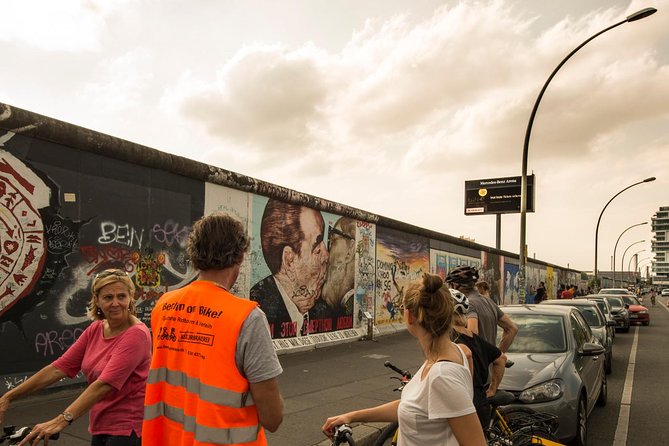
The ride then reaches the East Side Gallery, the open-air gallery painted on the longest remaining section of the Berlin Wall. Its location along the Spree, between Ostbahnhof and the Oberbaum Bridge, makes it one of Berlin’s most recognizable stretches of Wall.
The useful point here is context. At a glance, the painted panels can seem like a row of large murals. With the surrounding story, you can think about what happened after the Wall fell, how public art claimed the former barrier, and how the area changed from a symbol of division into a major public route.
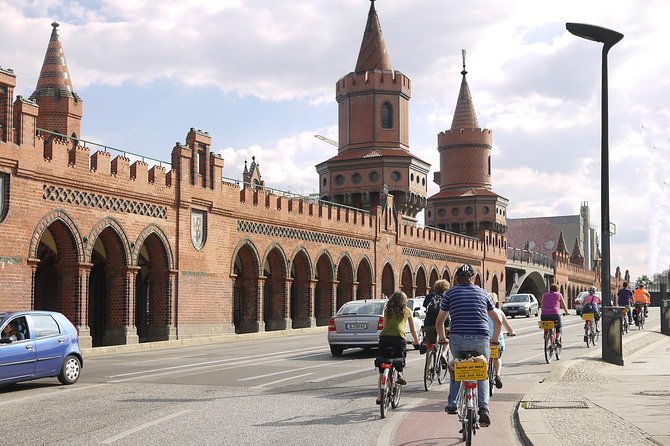
The Oberbaum Bridge links Friedrichshain and Kreuzberg and is one of the city’s most memorable crossings. Its red brick towers and double-level structure give the route a strong visual moment, but the bridge also carries political and neighborhood meaning. It is a literal connection between two districts that developed different reputations and identities.
Do not expect a long, quiet photo session at either site. You are cycling in a group through an active part of town. The guide may stop to explain a wall painting or point out a view, but the pace stays practical.
Contemporary art and the move into Kreuzberg
The route includes a center for modern visual arts with exhibitions, workshops, and an artist-in-residence program. The information provided does not identify the center by name, so you should treat this as a short look at Berlin’s working art culture rather than a scheduled gallery visit with guaranteed indoor access.
That distinction matters. This tour shows you how art fits into neighborhood life, but it is not designed for detailed examination of individual works. If you want a long museum visit, save that for another part of your Berlin schedule.
The ride into Kreuzberg continues the theme of a city in motion. You may hear about cultural clashes, squatter communities, street-art groups, and the way former industrial or neglected spaces take on new uses. These topics can be politically charged, and a good guide will help you understand them without pretending that Berlin’s alternative identity is frozen in time.
This is one reason I would choose this tour after a classic central Berlin sightseeing route. Once you have seen the Brandenburg Gate, Museum Island, and the major government buildings, this ride offers a different question: how do people actually use the city beyond its official image?
Görlitzer Park and the less polished Berlin experience
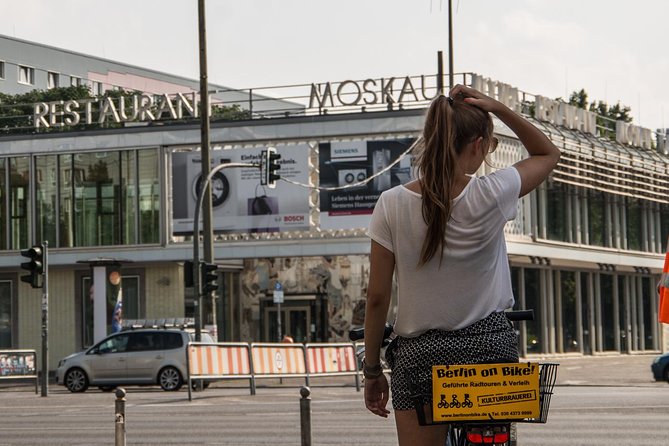
Görlitzer Park was created in the late 1980s and early 1990s after the old Görlitzer Bahnhof railway facilities were removed. It is now one of Kreuzberg’s major recreation areas.
The park can feel more complicated than Berlin’s postcard spaces. It reflects everyday urban pressures as well as recreation, and the tour’s wider themes include social tensions, contested public space, and local culture. That may be exactly what you want from an alternative route. It may also feel uncomfortable if you prefer a tidy sightseeing experience.
Your guide’s role matters here. The best version of this stop is not a quick label attached to a park. It is an explanation of how the space came to be, how people use it, and why Kreuzberg has attracted so many competing ideas about freedom, community, art, and public order.
Because the route includes parks and neighborhood streets, you get more than a line of famous attractions. You see ordinary residential areas, public spaces, and parts of Berlin you might not select on your own. The tradeoff is that the sights are less predictable and sometimes less photogenic than the city center.
How difficult is the cycling?
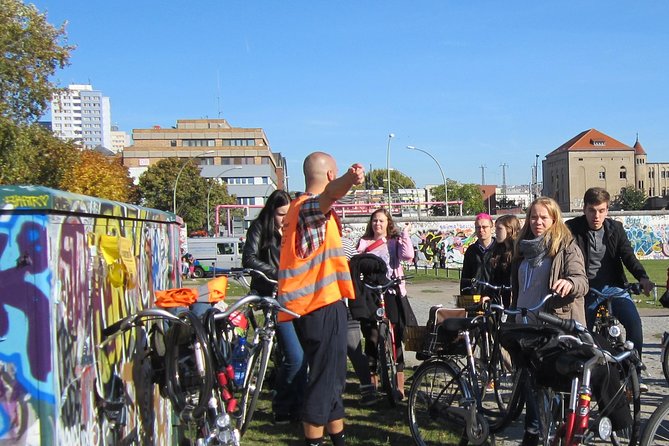
Berlin is fairly flat, and the ride is manageable for anyone with moderate physical fitness. Still, three and a half hours is a meaningful amount of time on a bicycle. You need to be comfortable starting, stopping, turning, and riding in a group.
The traffic question deserves an honest warning. One family found the mixture of car and bicycle traffic a little harrowing, especially for an 11-year-old, even though the guide handled the situation well. Another rider praised the wide roads and felt safe. Both impressions can be true, depending on the streets, traffic, weather, and your own cycling confidence.
The tour provides the bicycle and helmet, so you avoid the hassle of renting equipment separately. Past riders have also praised the bike condition. You should still dress for the weather and wear practical clothing. The operator runs in all weather, and the route is long enough that rain, wind, or heat will affect your comfort.
The maximum group size is 14. That is small enough for a guide to remember names and answer questions, while still large enough to create the usual group-riding delays. A smaller group also helps reduce waiting at crossings and regrouping points.
What the $43.54 price delivers
At $43.54 per person, the price is reasonable if you want transportation, equipment, and local interpretation in one afternoon. You are not paying for admissions, food, or drinks. You are paying mainly for the bike, helmet, guide, and the ability to cover several districts without arranging your own route.
The value is strongest if you are curious about Berlin’s alternative neighborhoods but do not feel ready to navigate them alone. A map can show you RAW Tempel, Karl-Marx-Allee, the East Side Gallery, and Görlitzer Park. It cannot easily explain how those places connect through East German planning, post-Wall art, nightlife, migration, activism, and redevelopment.
The price is less compelling if you only want Berlin’s famous monuments or a relaxed ride with few stops. You will spend much of the time cycling, and the route’s appeal depends on stories, atmosphere, and changing neighborhoods rather than entrance-ticket attractions.
The tour is booked, on average, 12 days ahead, so it is sensible to reserve early if the timing suits you. Free cancellation is available up to 24 hours before the 3 p.m. start. If poor weather or an insufficient number of bookings forces cancellation, you are offered another date or a full refund.
Who should book this ride?
I would choose this tour for a first or second visit when you want to get your bearings beyond central Berlin. It also suits repeat visitors who have already seen the standard sights and want a better feel for Friedrichshain and Kreuzberg.
Families can enjoy it, and a 14-year-old was reported to have had a great time. I would think carefully before bringing a younger child who is not comfortable in city traffic. The guide can help, but no guide can remove every road risk.
Art fans, urban-history enthusiasts, independent travelers, and anyone curious about Berlin’s club and street-art culture will get the most from it. You should also like some uncertainty. RAW, Görlitzer Park, and alternative cultural spaces are not polished attractions designed to please everyone.
The tour is offered in English. Food and drinks are not included, and there is no hotel pickup or drop-off, but the meeting point is near public transportation. Since the ride ends where it begins, getting back to your accommodation is straightforward once you return to the depot.
Should you book the Alternative Berlin Bike Tour?
Book it if you want Berlin as a lived-in city, not just a collection of famous buildings. The combination of Karl-Marx-Allee, RAW Tempel, East Side Gallery, Oberbaum Bridge, and Görlitzer Park gives you a strong look at the city’s divided past and inventive present.
Skip it if cycling in traffic makes you anxious, if you want a slow museum-centered afternoon, or if your Berlin schedule is too tight for a 3.5-hour outing. For everyone else, the price is fair, the equipment is included, and the small group format gives guides such as Anna, Paul, Marcus, and others room to add the personal stories that make this route work.
FAQ
Where does the Alternative Berlin Bike Tour start?
It starts at Berlin on Bike, Knaackstraße 97, at the Kulturbrauerei in Berlin.
What time does the tour start?
The scheduled start time is 3 p.m.
How long does the tour last?
The tour lasts approximately 3 hours and 30 minutes.
Where does the tour finish?
It finishes back at the Berlin on Bike meeting point.
Is the tour offered in English?
Yes. The tour is offered in English.
Is a bicycle included?
Yes. Use of a bicycle and helmet is included in the price.
How large is the group?
The tour has a maximum of 14 participants.
Do I need a certain level of fitness?
Yes. Participants should have moderate physical fitness because the experience includes an extended city bike ride.
What happens if the weather is poor?
The tour operates in all weather conditions, so you should dress appropriately. If the operator cancels because of poor weather, you are offered another date or a full refund.
Newly added rides around Berlin
- Berlin: Guided Private Bike Tour to Explore the Highlights★ 5.0 · 12 reviews
- Potsdam Bike Tour with Rail Transport from Berlin★ 4.5 · 81 reviews
- Small-Group Historical Bike Tour in Berlin★ 4.5 · 103 reviews
- Berlin : The best bike tour with a Berlin guide and insider tips★ 5.0 · 14 reviews
- Half-Day Bike Tour of Berlin’s Lesser Known And Historical Sites★ 5.0 · 10 reviews
- Berlin Wall and Cold War Bike Tour in Small Groups★ 5.0 · 114 reviews
- Berlin : Guided Private Sightseeing Tours with Funbikes, Teambikes★ 5.0 · 20 reviews
- Berlin: Guided Bike tour of the Berlin Wall and Third Reich★ 5.0 · 160 reviews
Berlin Bike Tours, compared.
Sights and Highlights Bike Tour with a Local Guide
Read our review →
Berlin Highlights Sightseeing Bike Tour in Small Groups
Read our review →
Alternative Bike Tour of Kreuzberg & Friedrichshain
Read our review →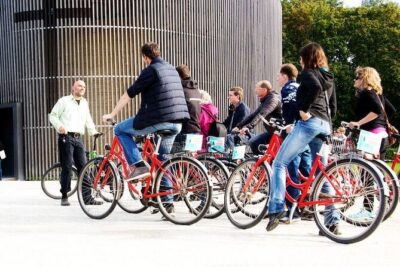
Browse the lists this tour appears in