
REVIEW · BERLIN BIKE TOURS
Berlin: Private Bike Tour of the Berlin Wall and Third Reich
Berlin’s hardest history fits on two wheels. This private bike tour links Berlin Wall sites, Nazi-era landmarks, and Holocaust memorials in a brisk three-hour ride, giving you far more ground than a walking tour. I especially like the private format, which lets your group shape the route, and the use of bicycles, which makes distant sites practical in one morning or afternoon.
The tour also reaches places many first-time visitors miss, including the Günter Litfin Memorial, Invalidenfriedhof, and the Humboldthain Flak Tower. The main drawback is its pace: ten minutes at many stops is enough for an explanation and photos, but not for a long, quiet visit. You’ll also need a minimum of four people to operate the tour.
Key points to know before you book
- A history-heavy route: The ride covers Berlin’s medieval core, Nazi planning, Holocaust memorials, the Wall, and Cold War tensions.
- Private and adjustable: Only your group takes part, and the guide can adapt the route to your interests.
- Bicycles save serious time: You can connect sites that would be awkward to reach on foot in just three hours.
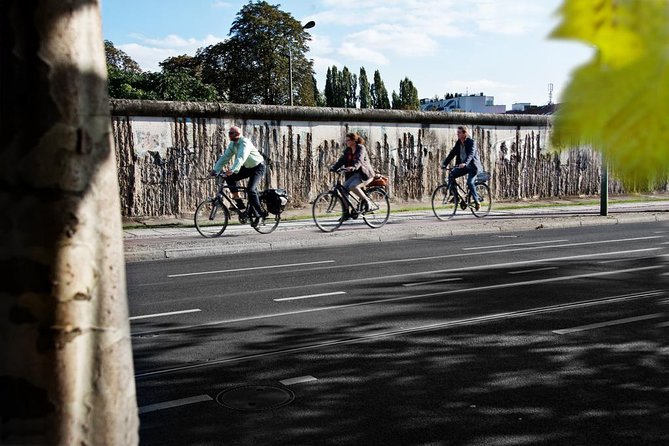
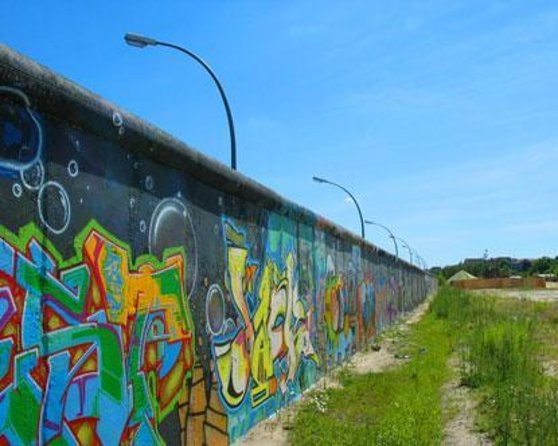
- The Wall is treated as lived history: The Berlin Wall Memorial and Mauerpark show how the border worked, not just where it once stood.
- English includes Checkpoint Charlie: The famous Cold War crossing is included on the English-language version.
- Best for groups of four or more: Bikes, helmets, and infant seats on request are included, but food, drinks, and hotel transfers are not.
Why a bicycle works so well for Berlin’s divided past
Berlin’s history is spread out. The Wall did not form one neat attraction, and the sites tied to the Third Reich sit among government buildings, parks, cemeteries, and ordinary streets. A bike lets you connect those pieces without spending half the tour waiting for public transport or walking between distant stops.
This is not a casual sightseeing ride with a few historical comments added. The route gives serious time to the forces that shaped modern Berlin: Nazi dictatorship, the Holocaust, wartime destruction, the division of the city, and the fall of the Wall. You will still be moving often, so this suits you if you prefer a clear story with many stops rather than one museum visit.
The tour begins at Free Berlin Bike Tours & Rental on Poststraße 11, near Nikolaiviertel. Bicycles and helmets are supplied, and the activity returns to the same meeting point. Several departure times are available, which helps you fit the ride around museum visits or other plans.
The operator reports a 4.9 rating from 23 reviews, with 96 percent of customers recommending it. The strongest praise centers on the guide’s clear English and the ability to cover much more ground than a walking tour. That benefit is real, but you should dress for the weather. The tour runs in all conditions.
More Private Bike Tours in Germany
- Private Berlin Street Food Tour by Bike
★ 5.0 · 87 reviews - The Beauty of Berlin by Bike: Private Tour
★ 5.0 · 59 reviews - Private Berlin Street Food Bike Tour
★ 4.9 · 42 reviews
Nikolaiviertel, Berlin’s old town with a complicated past
Nikolaiviertel is introduced as Berlin’s only real old town. It is a useful starting point because it raises an immediate question: how much of old Berlin survived wartime bombing and later rebuilding?
You get about ten minutes here, enough to set the scene rather than study every building. The stop helps you see Berlin as a city repeatedly remade, not a place with one untouched historic center. If you expect a large medieval quarter, adjust your expectations. This is a brief orientation stop, not a long architectural walk.
The New Synagogue and a story of civil courage
At the New Synagogue, also known as Centrum Judaicum, the guide tells the story of a police officer who helped protect the building during Kristallnacht, the Night of Broken Glass. The stop lasts about five minutes, so the focus is on the human decision at the heart of the story.
That short pause adds a useful balance to the larger political narrative. You are not only hearing about laws, armies, and borders. You are also considering what one person chose to do under a brutal dictatorship. The building itself gives the stop visual weight, even though you do not have time for an interior visit.
Holocaust memorials and Berlin’s competing ways of remembering
The route includes several memorials tied to the Holocaust and its victims. One stop presents a memorial created during the East German period for people deported and killed. Its setting and design offer a sharp contrast to the much more familiar Memorial to the Murdered Jews of Europe near Brandenburg Gate.
You also pass memorials connected with the largest victim groups of the Holocaust. The exact timing at these brief stops may vary with the route, but the larger point is clear: Berlin’s public memory developed across different political eras, and memorials do not all speak in the same visual language.
The most substantial memorial stop is the Memorial to the Murdered Jews of Europe. Its field of concrete blocks is difficult to take in from one angle, and the changing heights and spaces create an uneasy sense of disorientation. You get around ten minutes here. That is enough to walk among the blocks and hear the guide’s explanation, but not enough for the underground information center, which is not part of this tour.
This is one reason the bike tour works best as a first historical pass. You see the places, understand their role, and can return later to the memorials that deserve more time.
More Private Bike Tours in Berlin:
- Berlin : Guided Private Sightseeing Tours with Funbikes, Teambikes
★ 5.0 · 20 reviews - Private Highlights of Berlin Bike Tour
★ 5.0 · 13 reviews - Berlin: Guided Private Bike Tour to Explore the Highlights
★ 5.0 · 12 reviews - Barcelona: Private Group Bike Tour
★ 4.8 · 1,420 reviews
The Berlin Wall Memorial: the clearest place to understand the border
The Berlin Wall Memorial receives about ten minutes, but it carries some of the tour’s greatest value. The guide presents this as the section where you can best understand what the Wall did to Berlin, rather than treating it as a strip of concrete left behind for photographs.
The Wall was not simply one barrier. It involved layered defenses, restricted ground, watch points, and the forced separation of neighborhoods. At this stop, the physical remains help you picture that system. The explanation matters because a surviving fragment alone can look strangely harmless. Context shows why it was so powerful.
You should not expect a long visit to every part of the memorial complex. The tour is designed to connect many locations, so the guide gives you the central idea and moves on. If the Wall is your main interest, you may want to return independently after the ride.
Mauerpark and the failed search for a perfect border
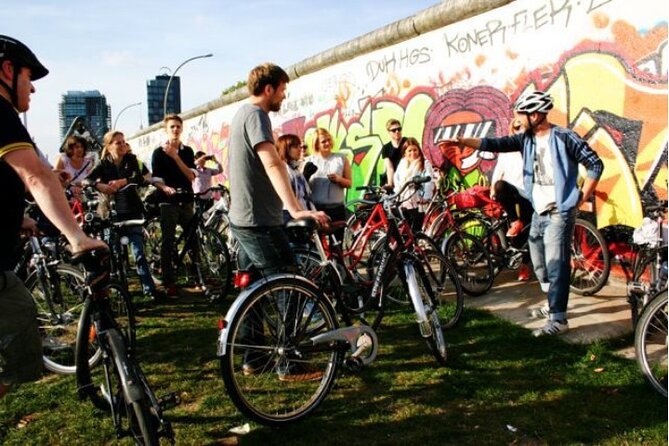
Mauerpark is now best known for its Sunday flea market, but the tour uses it to explain East Germany’s repeated attempts to create what its rulers saw as a perfect border. The contrast is striking: a place associated with weekend leisure once formed part of a controlled and dangerous divide.
You get about ten minutes here. The stop works well because it links present-day Berlin with the physical logic of the former border. You can understand how a familiar public space carried a very different purpose before reunification.
The market itself is not the focus, so do not book this ride mainly for flea-market time. The tour is about the site’s political and military meaning.
Humboldthain Flak Tower and the heavy remains of Nazi Berlin
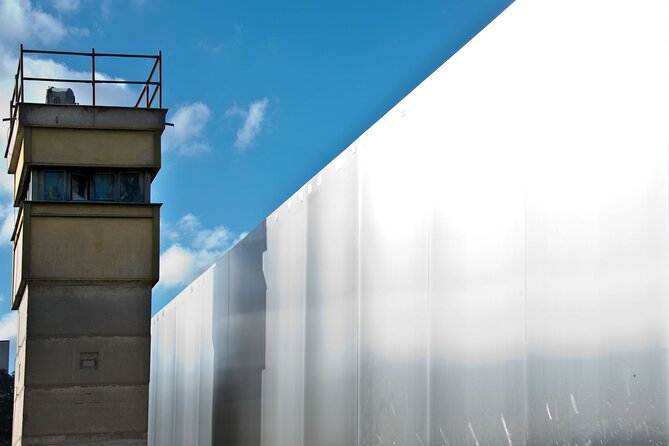
The Humboldthain Flak Tower was both a giant fortress and an air-raid shelter. The tour uses the structure to discuss Nazi architecture and wartime defense, while also offering a panoramic view of Berlin.
This is one of the more unusual stops because the history is written into a massive piece of concrete. The tower shows how Nazi Germany combined military need, monumental scale, and urban control. It also gives you a chance to look across the city and connect the historical sites you have already seen.
The stop lasts about ten minutes. The route information does not promise an interior visit, so expect to view and discuss the tower rather than take a full underground or structural tour. The panoramic outlook is a welcome change after several memorials and dense historical explanations.
Günter Litfin Memorial and the human cost of the Wall
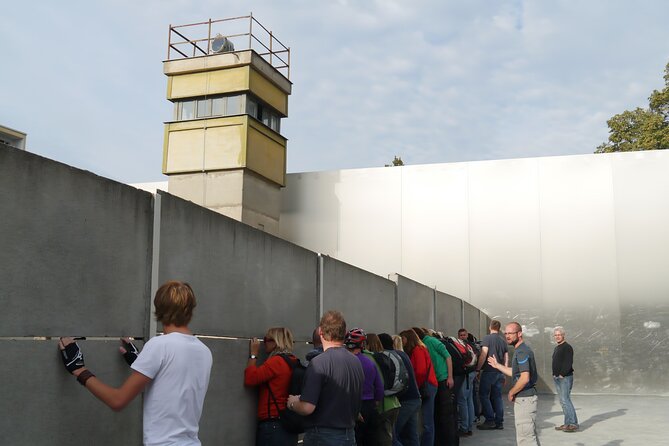
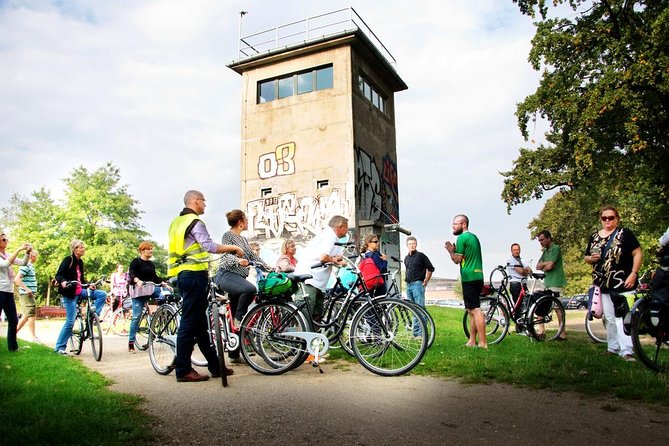
The Günter Litfin Memorial preserves an original watchtower in memory of Günter Litfin, identified here as the first person shot at the Wall. The tower makes the border feel less abstract. Instead of hearing only about dates and political decisions, you confront the machinery that watched and controlled movement.
You have around ten minutes at the site. That is enough for the guide to explain the memorial and for you to grasp its setting, though not for an extended visit. I find this kind of stop especially useful for people who know the broad Cold War story but have not yet considered how quickly an attempt to cross could become fatal.
Invalidenfriedhof, military memory cut by the border
Invalidenfriedhof was created for figures from German military history. The Berlin Wall later cut through the cemetery, disrupting graves and turning a burial ground into part of the border zone.
The guide also raises a difficult question about whom Germany should honor and whom it should remember with caution. That distinction matters. Military importance and moral approval are not the same thing, and a cemetery can preserve both admirable service and troubling legacies.
You spend about ten minutes here. The stop is quieter and more reflective than Checkpoint Charlie, with less spectacle and more room for questions. It also shows how the Wall damaged places that were not built for politics at all.
Spreebogenpark and Hitler’s planned Great Hall
From Spreebogenpark, you get a broad view of Germany’s government district. The modern buildings are only part of the story. The guide also explains Albert Speer’s plans for Hitler’s new capital, including the proposed Great Hall, which was intended to hold 180,000 people.
That plan reveals the scale of Nazi ambition. The project was not simply about constructing offices or monuments. It aimed to remake Berlin as a capital of imperial power, with architecture designed to overwhelm the individual.
This stop lasts about fifteen minutes, longer than most points on the route. That extra time helps because the subject needs explanation. You can compare the present government quarter with the city Hitler’s planners wanted to create, even though the proposed Great Hall was never built.
The Reichstag and the struggle over German democracy
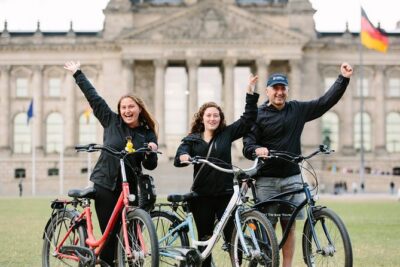
At the Reichstag, the guide discusses Hitler’s rise to power and Germany’s democratic history. You view the building from outside, with roughly five minutes for the stop.
The brief visit is practical but limited. You will not go inside or visit the glass dome on this tour. Still, the Reichstag is an effective place to discuss how democratic institutions can be weakened and captured. Its location also makes the shift from dictatorship to modern parliamentary government easy to picture.
If you want the interior, you will need to arrange that separately. The bike tour gives you the historical framework, not a Reichstag admission.
The Führerbunker and why there is almost nothing to see
At the former Führerbunker, the visible attraction is almost nothing. Today, you see a parking lot. The guide explains why the site was covered and why the location is not marked with a grand monument.
That absence is useful. A dramatic ruin could turn the place into a morbid attraction, while a plain surface denies the site easy spectacle. You spend about ten minutes discussing Hitler’s final weeks and suicide there, along with the decisions that shaped the site’s present appearance.
This is a stop where the explanation matters far more than the view. If you need a preserved bunker interior, you will be disappointed. If you want to understand how Berlin handles a location tied to dictatorship, the stop earns its place.
Checkpoint Charlie and the Cold War flashpoint
The English-language version includes Checkpoint Charlie, the most famous former border crossing between East and West Berlin. The tour explains its role as a crossing associated with the United States and Soviet Union, and how a confrontation there came close to triggering a much larger conflict.
You get about ten minutes. The site is now surrounded by modern commercial activity and photo opportunities, so the guide’s context helps separate the real Cold War danger from the present-day display. Checkpoint Charlie is famous, but it is not the best surviving section of the Wall. Its value lies in the political confrontation connected with the crossing.
The supplied tour details specify Checkpoint Charlie for the English version only. If you choose German or another requested language, confirm the planned route before you set out.
What $107.42 buys you
At $107.42 per person, this is not a bargain-priced city bike rental. You are paying for a private guide, bicycle, helmet, a carefully connected historical route, and the ability to shape the experience around your group.
The value improves when four or more people share the experience, especially if you already planned to visit several Wall and Nazi-era sites. A walking route covering this much ground would take much longer. One clear English-language tour review praised exactly that advantage, noting that the bicycle made it possible to see the attractions in roughly half the time.
The price is harder to justify if you want long visits at each memorial, museum interiors, or unhurried photography. In that case, use the tour as an orientation and return to the most important places on your own.
Children are welcome, and infant seats can be provided on request. Every child must be accompanied by an adult. The tour does not include hotel pickup, food, or drinks, so plan those separately.
Who should book this private ride?
I would choose this tour if you have a strong interest in Berlin’s political history and want a guide to connect places that feel scattered on a city map. It suits families with older children, friends traveling together, and history-focused groups that prefer private discussion to a large scheduled tour.
It is also a good choice if this is your first serious look at Berlin’s Wall and Third Reich sites. The guide gives you a framework, while the bicycle keeps the route moving.
I would think twice if you dislike cycling, want a slow memorial visit, or prefer museums and indoor exhibits. The ride operates in all weather, so you need suitable clothing. Since the tour requires at least four participants, solo visitors and pairs may need to arrange additional people before booking.
Final call: a strong first look at difficult Berlin history
Book it if you want breadth, context, and private guiding in one compact ride. The route reaches famous sites such as the Reichstag, Holocaust Memorial, and Checkpoint Charlie, but its best moments may come at the less obvious places: the Litfin tower, Invalidenfriedhof, Humboldthain Flak Tower, and the Wall Memorial.
Skip it if you want to enter buildings or linger at every stop. For the right group, though, the bicycles turn a spread-out and emotionally heavy subject into a clear three-hour introduction. You finish at the starting point with a better sense of how Nazi rule, war, division, and reunification are written into Berlin’s streets.
FAQ
How long does the private bike tour last?
The tour lasts approximately three hours.
What is the price per person?
The listed price is $107.42 per person.
Where does the tour begin?
It begins at Free Berlin Bike Tours & Rental, Poststraße 11, 10178 Berlin, Germany.
Where does the tour end?
The activity ends back at the meeting point.
Is this a private tour?
Yes. Only your group takes part in the activity.
How many people are required to operate the tour?
The tour operates with a minimum of four people.
Is Checkpoint Charlie included on every language version?
Checkpoint Charlie is included on the English version. Other language routes may differ.
Are bicycles and helmets provided?
Yes. The use of a bicycle and helmet is included. Infant seats can be provided on request.
What languages are available?
The tour is offered in English and German. Dutch, French, and Spanish may also be possible on request.
Newly added rides around Berlin
- Potsdam Bike Tour with Rail Transport from Berlin★ 4.5 · 81 reviews
- Berlin: Guided Private Bike Tour to Explore the Highlights★ 5.0 · 12 reviews
- Alternative Berlin Bike Tour – Off the Beaten Tracks in Small Groups★ 5.0 · 99 reviews
- Small-Group Historical Bike Tour in Berlin★ 4.5 · 103 reviews
- Berlin : The best bike tour with a Berlin guide and insider tips★ 5.0 · 14 reviews
- Half-Day Bike Tour of Berlin’s Lesser Known And Historical Sites★ 5.0 · 10 reviews
- Berlin Wall and Cold War Bike Tour in Small Groups★ 5.0 · 114 reviews
- Berlin : Guided Private Sightseeing Tours with Funbikes, Teambikes★ 5.0 · 20 reviews
Berlin Bike Tours, compared.
Sights and Highlights Bike Tour with a Local Guide
Read our review →
Berlin Highlights Sightseeing Bike Tour in Small Groups
Read our review →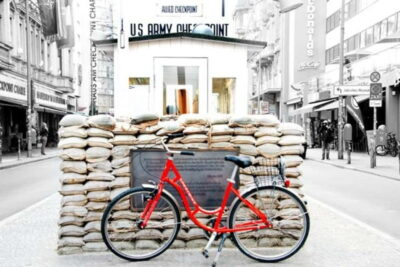
Alternative Bike Tour of Kreuzberg & Friedrichshain
Read our review →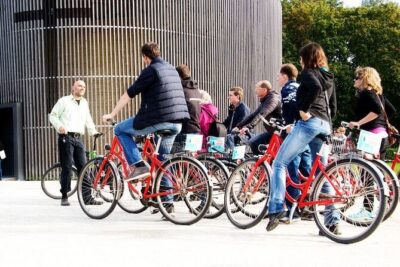
Browse the lists this tour appears in