
REVIEW · BERLIN BIKE TOURS
Berlin: Small Group Bike Tour Through City Center
Berlin reveals itself best on two wheels. This 210-minute ride links the former Wall border at Bornholmer Straße with the Brandenburg Gate, government district, Museum Island, and Alexanderplatz, giving you a useful first look at Berlin’s divided past and united present. I especially like the small group of no more than eight and the route’s mix of major sights and less obvious city corners.
I also like that the tour includes a bicycle and guide for $40, a fair price for three and a half hours of sightseeing. The main consideration is language: the live tour is in German, and there is no scheduled food or drink stop. Bring water, and do not expect a slow café ride. One recent participant enjoyed the route so much that an extra one or two hours, with a break, would have been welcome.
Key points before you book
- Bornholmer Straße gives the tour a meaningful start: You begin where East and West Berliners embraced on November 9, 1989, the night the Wall fell.
- Eight people is the maximum: The group size should make it easier to hear the guide and keep the ride moving together.
- The route covers Berlin’s major symbols: You see the Reichstag, Brandenburg Gate, Holocaust Memorial, Berlin Cathedral, TV Tower, and East German World Clock.
- You get both old and new Berlin: The ride moves from the New Synagogue and Bebelplatz to Hauptbahnhof, Potsdamer Platz, and modern government buildings.
- Richard received special praise: His personal stories and clear explanations helped make one group’s ride particularly memorable.
- Plan for weather and hydration: The tour runs in rain, ponchos are provided, and one participant wished they had brought a water bottle.
Starting at Bornholmer Straße, where the Wall opened
The meeting point is BBT Fahrradladen at 75 Bornholmer Straße, in the northern part of Berlin’s Mitte area. Arrive 20 minutes early so you have time to check in and get fitted with a bicycle. The shop is one minute from the Björnsonstraße tram stop, two minutes from Bornholmer Straße S-Bahn station, and about 10 minutes from Schönhauser Allee.
The opening stop is not just a convenient place to collect a bike. Bornholmer Straße was the first Berlin Wall crossing to open on November 9, 1989. East Berliners began crossing into the West here, and people from both sides celebrated together. Starting at this site gives the tour a clear purpose: you are not simply ticking off monuments, you are following the story of how Berlin changed.
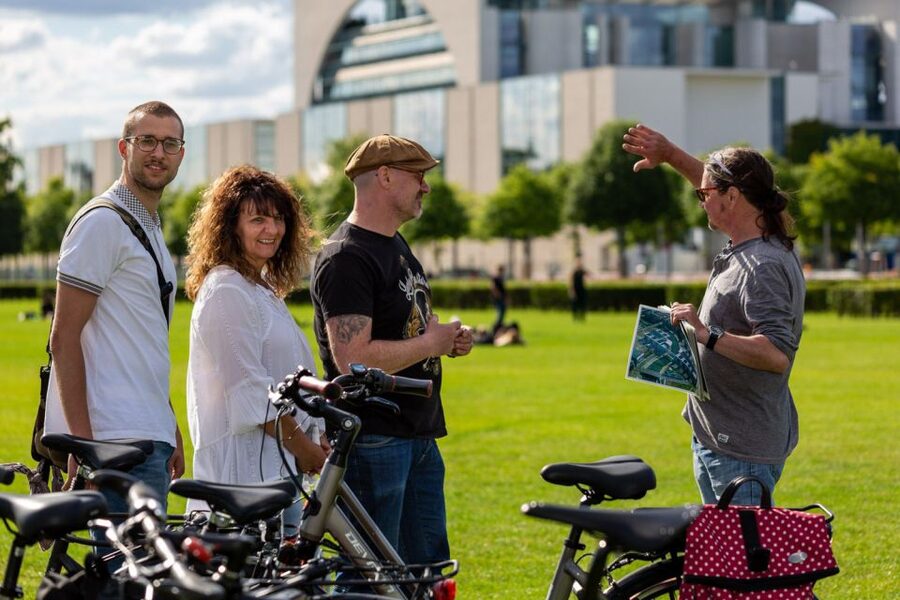
Your guide may add personal memories and local details. That matters here because the Wall’s fall can feel distant when reduced to a date in a history book. The tour’s strongest feedback centers on guides who explain events through their own experiences. Richard, in particular, was praised for personal stories, useful information, and a friendly manner.
A few more rides around Berlin worth a look
- Berlin: Sights and Highlights Bike Tour with a Local Guide
★ 4.8 · 2,698 reviews - Berlin Highlights 3-Hour Bike Tour
★ 5.0 · 948 reviews - Berlin City Bike Tour with Beer Garden Stop
★ 5.0 · 917 reviews
From the New Synagogue to Berlin’s changing center
From Bornholmer Straße, the ride heads toward the city center and the New Synagogue, also known as the Jewish Centre. Its ornate exterior and large golden dome make it one of Berlin’s most recognizable religious buildings. The stop introduces the Jewish history of Berlin and the damage done during the Nazi period and the Second World War, although the exact amount of time spent at each sight can vary.
The Old Post Headquarters follows as another reminder of Berlin’s earlier urban life. Then the route passes the Friedrichstadt-Palast, a major entertainment venue. These stops help break up the usual monument-heavy tour. You see Berlin not only as a capital of government and memorials, but also as a city of theaters, offices, streets, and working institutions.
The ride continues past the Charité, one of Berlin’s best-known medical institutions, and the Hauptbahnhof. The contrast is sharp. The Charité represents an older center of science and public life, while Hauptbahnhof is a sleek modern transport hub built near the Spree. I like this part of the route because it makes Berlin’s rebuilding visible without needing a long lecture.
The Reichstag and the government district
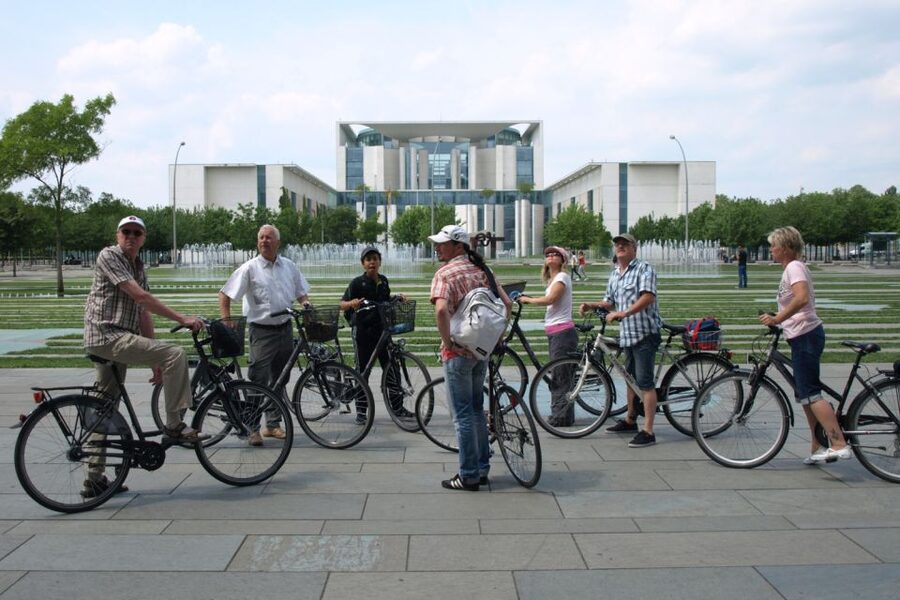
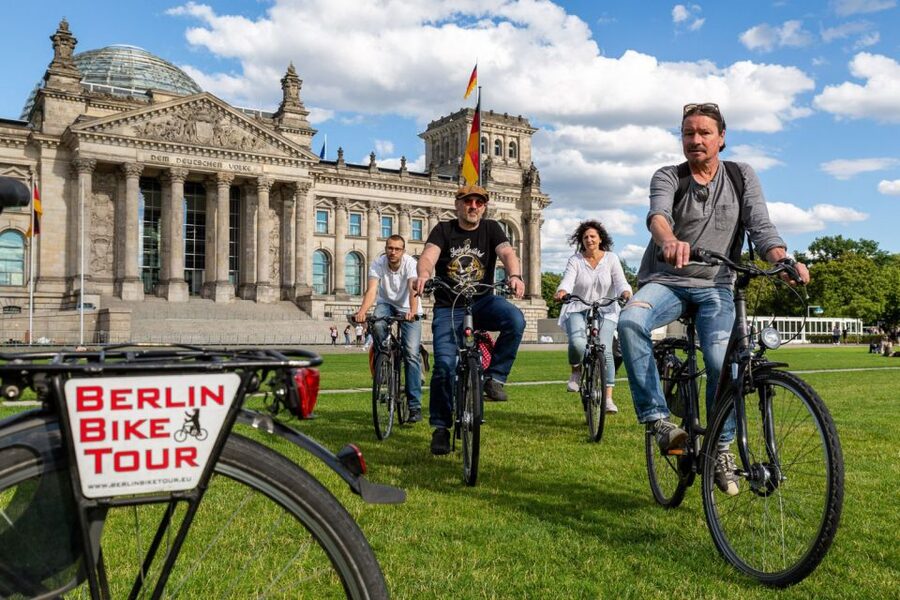
The government district brings you to the Marie-Elisabeth-Lüders-Haus and the Reichstag. The area is a useful lesson in modern Berlin: broad public spaces, large government buildings, and architecture designed for a reunited capital.
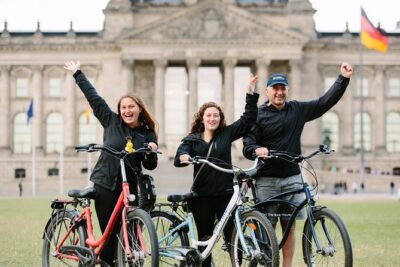
The Reichstag is one of the essential stops. It became a symbol of a united Germany after reunification, and its glass dome is now one of Berlin’s most recognizable features. You should think of this as an outside sightseeing stop rather than a dome visit. The tour information lists the Reichstag as part of the bicycle route, not an interior entry.
The government quarter is well suited to a bike tour because you can cover several major buildings without spending your time walking between them. The guide can also connect the buildings to Berlin’s political story. If you are interested in twentieth-century history, this portion should be one of the most useful parts of the ride.
Tiergarten, Brandenburg Gate, and the Holocaust Memorial
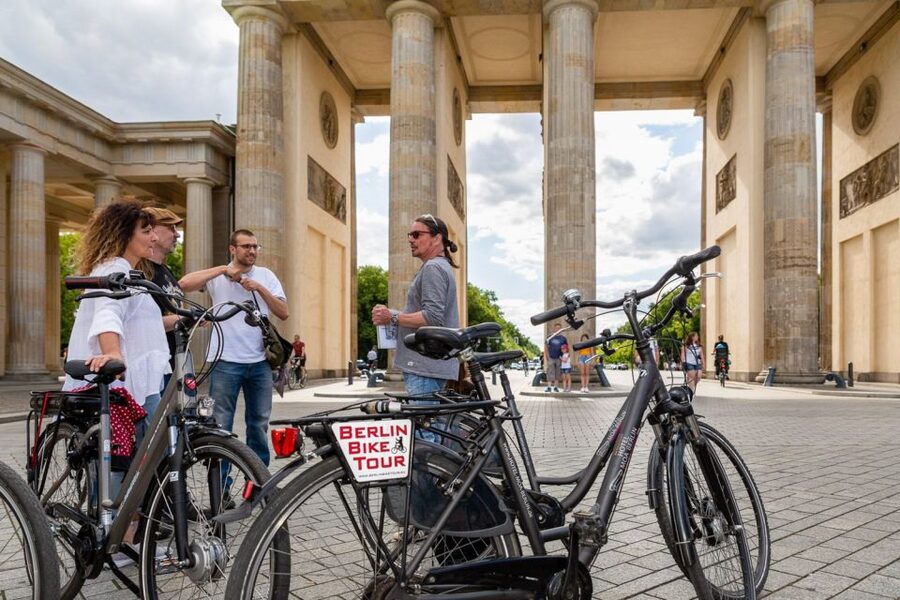
After the government district, you cycle through the Tiergarten, Berlin’s large central park. It offers a change of pace from stone buildings and traffic. The park is often described as Berlin’s version of Central Park, and on this route it functions as a pleasant green link between the government quarter and the city’s best-known monument.
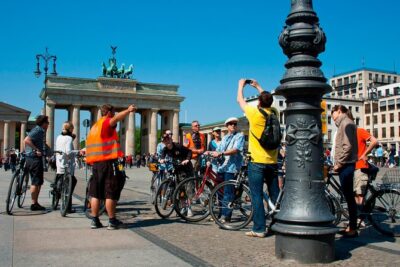
The Brandenburg Gate comes next. Once associated with a divided city, it now represents Berlin’s reunification and is the image most people carry home from the capital. Seeing it after Bornholmer Straße and the Reichstag gives the monument more meaning. You have already followed the Wall’s fall and the creation of a new political center.
The Holocaust Memorial is nearby. Its field of concrete blocks is powerful, but it is also easy to rush through on a bicycle tour. You will have time to see it from the outside and hear the guide’s explanation, yet this is not a substitute for visiting the underground information center if you want a fuller account of individual Jewish lives and families. The tour gives you orientation, not a complete museum visit.
Same handlebars, a completely different route:
- Berlin Highlights: 3-Hour Bike Tour
★ 4.9 · 809 reviews - Berlin Highlights Sightseeing Bike Tour in Small Groups
★ 5.0 · 652 reviews - Berlin: The Wall and Third Reich Guided Bike Tour
★ 4.8 · 578 reviews - Berlin: Alternative Bike Tour of Kreuzberg & Friedrichshain
★ 4.7 · 548 reviews
Potsdamer Platz and the city’s rebuilt center
The route continues to Potsdamer Platz, where modern Berlin replaces much of the older street fabric. The area is a useful example of the city’s post-reunification rebuilding. It also keeps the tour from presenting Berlin as a museum of old monuments.
This part may appeal most to you if you like architecture and urban change. The route does not stay only with imperial buildings or war memorials. Instead, it shows how Berlin filled in former divided and damaged spaces with new offices, public areas, and transport links.
A bicycle makes the transition easier to understand because you move through the areas in sequence. On foot, the same route would take longer and feel more fragmented. The tradeoff is that you do not get extended time at every location, so keep a note of places you want to revisit independently.
Gendarmenmarkt, Bebelplatz, and Unter den Linden
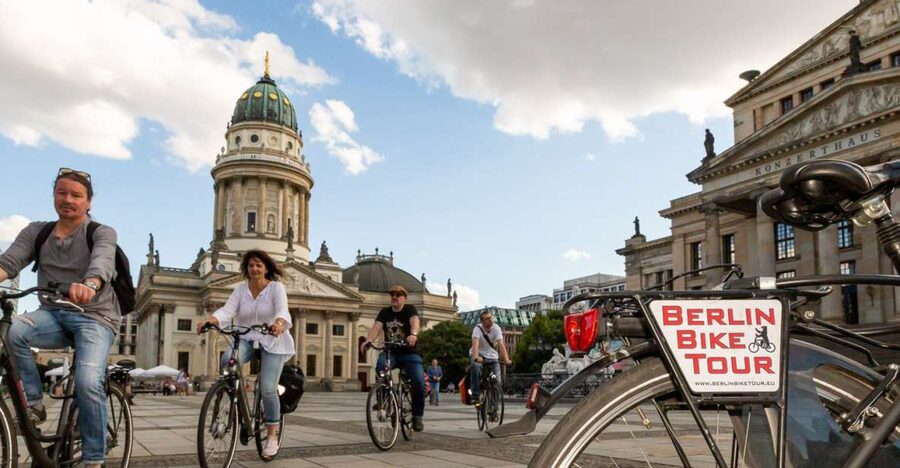
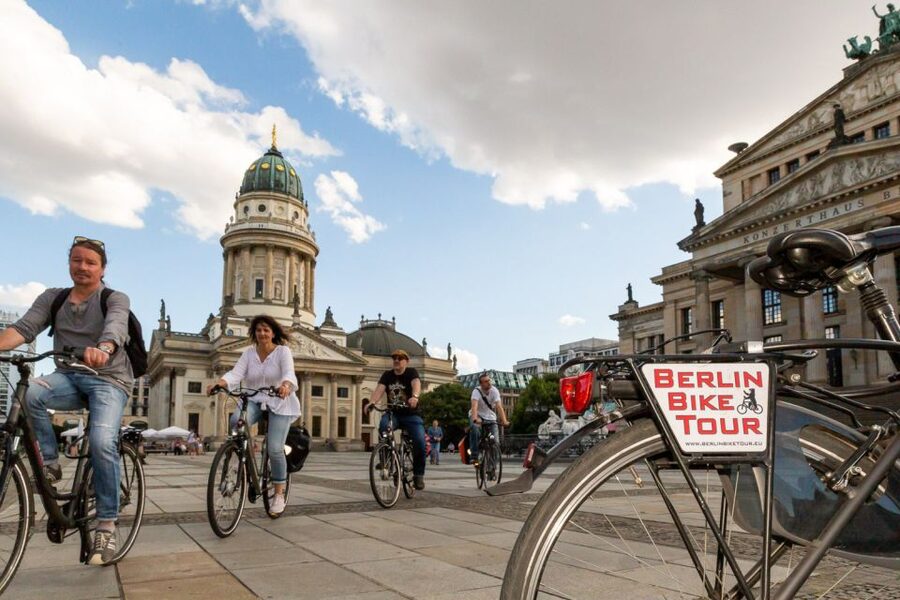
Gendarmenmarkt brings a more formal architectural setting. The Deutscher Dom and French Cathedral face the square, creating one of Berlin’s most elegant urban scenes. The buildings show the city’s Prussian and religious past, while the surrounding streets remind you that this is still a working central district.
The ride then reaches Bebelplatz, a site closely tied to Nazi book burning. Nearby, Humboldt University adds another layer of Berlin’s intellectual history. The guide can connect the square, university, and surrounding buildings to the political changes that shaped the capital.
Unter den Linden is the grand avenue tying many central sights together. Cycling along it helps you understand the structure of old Berlin. The route then passes Berlin Cathedral and Schlossplatz, where historic royal associations meet the rebuilt center of the modern city.
These sections pack in a lot of names and visual information. I would not expect to remember every building after one pass. The value is in seeing how the sites relate to one another, then choosing which ones deserve a longer visit later.
From Nikolaiviertel to Alexanderplatz
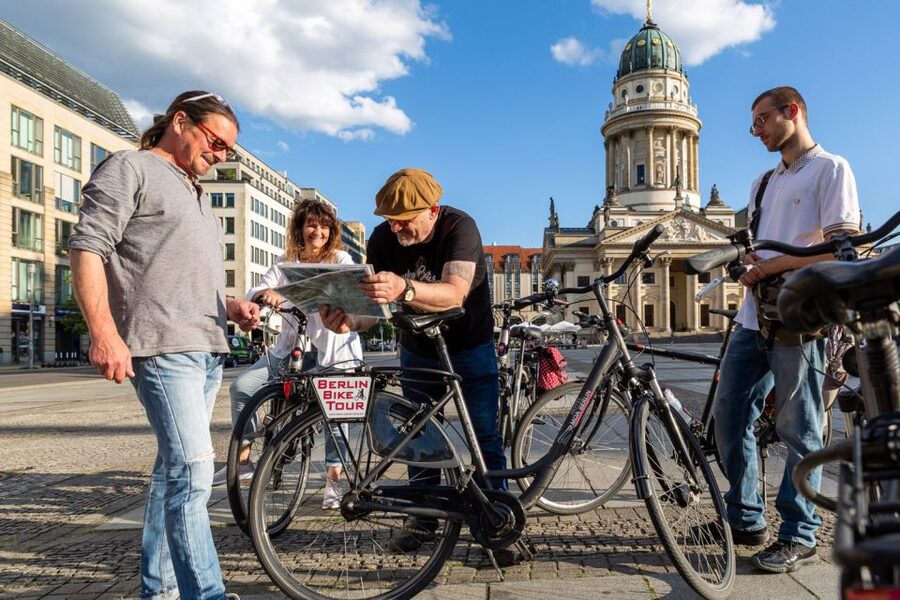
Nikolaiviertel offers a smaller-scale contrast after the broad avenue of Unter den Linden. It is associated with Berlin’s oldest city center and has a more compact, old-town feel. From there, the route moves to the Red Town Hall, the Neptun Fountain, and Marienkirche.
The Red Town Hall is a major civic building, while the fountain and church help fill in the visual story of central Berlin. You will see how close the city’s medieval associations, nineteenth-century government buildings, socialist-era projects, and modern towers sit to one another.
Alexanderplatz is the final major district before the return ride. The TV Tower dominates the skyline and remains one of the clearest symbols of East Berlin. The East German World Clock is another distinctive stop. It shows world cities and time zones, and it remains one of the square’s most recognizable pieces of socialist-era design.
The route also passes the Park Inn by Radisson Berlin Alexanderplatz. That may sound like a minor detail, but it helps orient you in one of Berlin’s largest public squares. After Alexanderplatz and the World Clock, you cycle through Prenzlauer Berg on the way back to the starting point.
Prenzlauer Berg and the final ride home
Prenzlauer Berg is presented as part of the new Berlin, and it gives the final stretch a more local, residential feel. It is a fitting counterpoint to the formal government quarter and the grand monuments near Unter den Linden.
The return to Bornholmer Straße completes a broad loop through central Berlin. You begin with the Wall’s opening and finish in a district associated with the city’s newer identity. That shape gives the tour a stronger narrative than a simple out-and-back ride.
The full trip lasts 210 minutes, so you should expect steady movement and several short sightseeing pauses rather than long visits inside buildings. One group of eight found the bicycles good and wished they had brought water. Another group of six described the ride as especially successful. Those details point to the right mindset: bring a bottle, pace yourself, and treat the tour as an overview that helps you plan later visits.
What $40 gets you
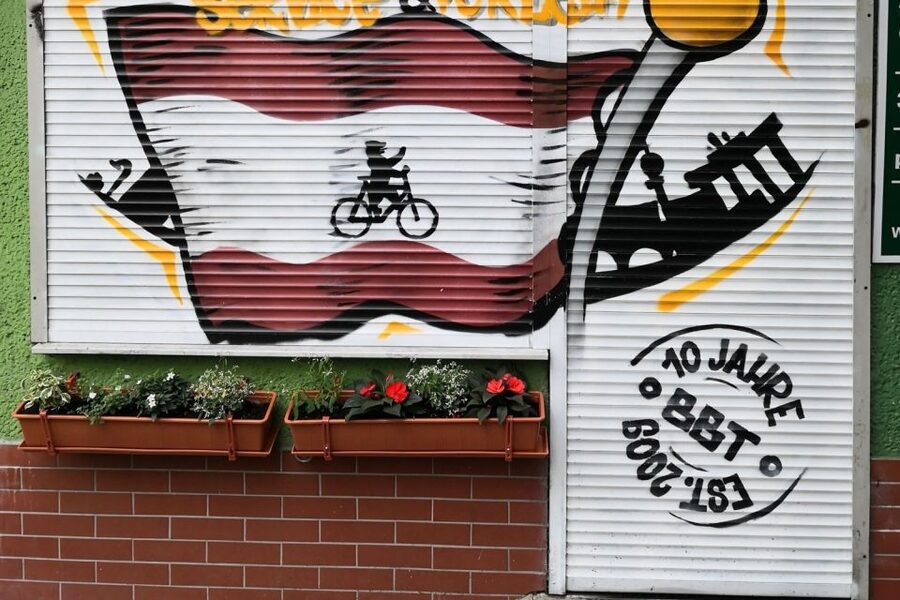
At $40 per person, the tour offers solid value if you want a guided introduction to Berlin rather than a basic bicycle rental. The price includes the bicycle, a city guide, and a rain poncho if needed. You cover a large section of the city and receive historical context along the way.
The value depends on the guide and your comfort with the German language. The listed tour language is German, so you should book only if you understand German well enough to follow spoken explanations. The personal storytelling praised in the feedback is a real advantage for German speakers, but it will not help much if you cannot understand the guide.
Food and drinks are not included. There is no stated meal break, and the route is long enough that you should eat beforehand and carry water. Large bags and luggage are not allowed, so bring only what you can manage comfortably on a bicycle. Sunglasses, a sun hat, a camera, and an identity document are listed as useful items.
The tour runs in all weather. Rain ponchos are provided on wet days, but suitable clothing is still sensible. You should not book this as a weather-dependent activity unless you are comfortable riding in rain.
Who should book this Berlin bike tour?
I would choose this tour if you want to see many key sights in one morning or afternoon and prefer a guide’s explanation to a self-guided route. It suits first-time visitors who want a strong geographic overview, history-minded visitors who understand German, and people who enjoy cycling between landmarks instead of taking a coach.
It is less suitable if you want long museum visits, a relaxed café stop, or an English-language guide. It may also feel fast if you prefer to study every monument closely. The route has many stops, so the reward is breadth and connection rather than extended time at any single site.
The 4.9 rating from 64 reviews supports the tour’s strongest qualities: clear information, engaging storytelling, friendly guides, and good bicycles. The most useful criticism is equally clear: the ride is full enough that you may wish for more time and a pause. Bring water and treat the tour as your introduction to Berlin’s center.
Should you book it?
Book this tour if you want a compact, history-focused ride through Berlin’s changing identity and can follow German. The small group, broad route, included bicycle, and $40 price make it a sensible way to get your bearings fast without spending the day underground or on foot.
Skip it if you need English commentary, cannot ride comfortably for three and a half hours, or want interior visits at the Reichstag, Holocaust Memorial, or other major sights. For the right rider, this is an efficient and unusually well-connected first look at Berlin, from the Wall’s fall at Bornholmer Straße to the World Clock at Alexanderplatz.
FAQ
How long does the Berlin bike tour last?
The tour lasts 210 minutes, or three and a half hours.
What is the tour price?
The listed price is $40 per person.
How many people can join the group?
The group is limited to eight participants.
What language is the guided tour in?
The live tour guide speaks German.
Where does the tour begin and end?
It begins and ends at BBT Fahrradladen, Fahrradwerkstatt & Fahrradverleih, at 75 Bornholmer Straße, Berlin 10439.
What is included in the price?
A bicycle, a city guide, and a rain poncho when necessary are included.
Does the tour run in rainy weather?
Yes. The tour takes place in all weather, and rain ponchos are provided on rainy days.
Can I bring luggage or a large bag?
No. Luggage and large bags are not allowed.
Newly added rides around Berlin
- Potsdam Bike Tour with Rail Transport from Berlin★ 4.5 · 81 reviews
- Berlin: Guided Private Bike Tour to Explore the Highlights★ 5.0 · 12 reviews
- Alternative Berlin Bike Tour – Off the Beaten Tracks in Small Groups★ 5.0 · 99 reviews
- Small-Group Historical Bike Tour in Berlin★ 4.5 · 103 reviews
- Berlin : The best bike tour with a Berlin guide and insider tips★ 5.0 · 14 reviews
- Half-Day Bike Tour of Berlin’s Lesser Known And Historical Sites★ 5.0 · 10 reviews
- Berlin Wall and Cold War Bike Tour in Small Groups★ 5.0 · 114 reviews
- Berlin : Guided Private Sightseeing Tours with Funbikes, Teambikes★ 5.0 · 20 reviews
Berlin Bike Tours, compared.
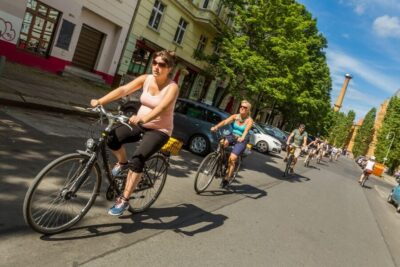
Sights and Highlights Bike Tour with a Local Guide
Read our review →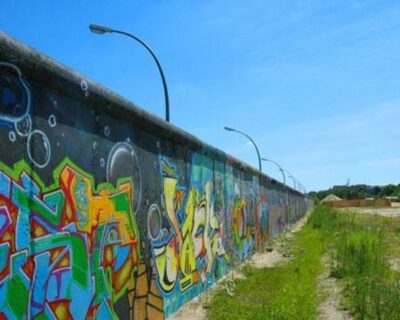
Berlin Highlights Sightseeing Bike Tour in Small Groups
Read our review →
Alternative Bike Tour of Kreuzberg & Friedrichshain
Read our review →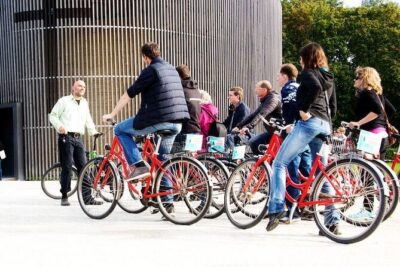
Browse the lists this tour appears in