
REVIEW · BERLIN BIKE TOURS
Berlin : The best bike tour with a Berlin guide and insider tips
See Berlin’s story on two wheels. This three-hour ride connects Cold War checkpoints, Nazi-era memorials, royal parks, government buildings, and old Berlin squares in one compact route. I especially like the small group of no more than 10 people and the chance to cover far more ground than you could comfortably walk. I also like that the tour uses English and includes a bicycle, so you can focus on the city instead of arranging gear.
The main tradeoff is pace. You stop often, but many visits last only five or ten minutes, and admission tickets are not included. This is best for seeing the city’s major sights from the outside and getting useful orientation, not for long museum visits or quiet study at each memorial.
Key points at a glance
- A broad three-hour route: Cover Checkpoint Charlie, the Brandenburg Gate, the Reichstag, Museum Island, Alexanderplatz, Bebelplatz, and more without changing transport.
- A small English-speaking group: The maximum group size is 10, which gives the guide a better chance to answer questions and keep the ride together.
- History from several eras: The route links the Nazi period, the Berlin Wall, the divided city, reunification, Prussian Berlin, and present-day government.
- Parks add breathing room: Tiergarten and the area around Bellevue Palace break up the serious historical stops with open green space.
- Useful for a short visit: If you have limited time in Berlin, this gives you a quick first look at a large part of central Berlin.
- Good value at $36.57: The bicycle and guide are included, while meals and any paid admissions are not.
What this Berlin bike tour does well
Berlin is spread out, and its major sights do not line up in a neat walking loop. A bike helps solve that problem. In three hours, you move from former East-West border points to the government district, then on toward Museum Island and the older city center.
I like the way this route treats Berlin as more than a collection of famous buildings. You see the city’s political power, its painful 20th-century history, its memorials, its parks, and its rebuilt historic districts. That mix gives you a better first impression than a tour focused only on postcard sights.
The guide is Dio, whose English and knowledge were praised in the feedback provided for this experience. That matters here because many stops require explanation. A parking lot at the Führerbunker site, for example, means little without context. The same is true of Bebelplatz, where the most important part of the memorial is below ground.
At $36.57 per person, the tour offers fair value if you want an overview. You are paying for the bicycle, the guide, and the route planning. You are not paying for food, museum entry, or extended time inside attractions. Think of it as a moving orientation tour with history built into the stops.
A few more rides around Berlin worth a look
- Berlin: Sights and Highlights Bike Tour with a Local Guide
★ 4.8 · 2,698 reviews - Berlin: The Wall and Third Reich Guided Bike Tour
★ 4.8 · 578 reviews - Berlin: Guided Bike Tour to Explore the Highlights
★ 4.8 · 506 reviews
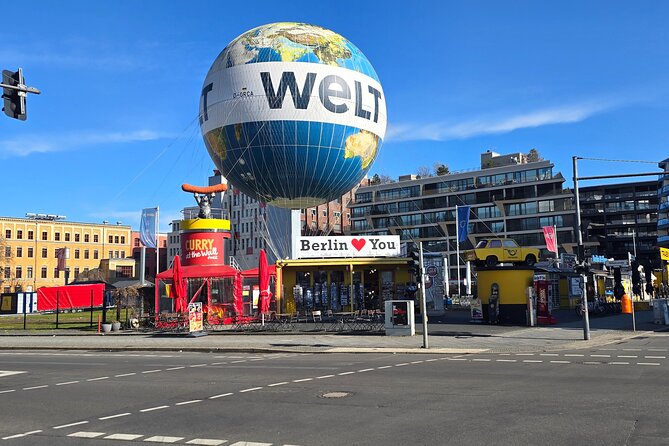
Starting in Kreuzberg and reaching Checkpoint Charlie
The ride begins at Lindenstraße 28 in Berlin’s 10969 district and returns to the same meeting point. The location is near public transportation, which makes the start and finish practical if you are staying elsewhere in the city.
Checkpoint Charlie is one of Berlin’s best-known Cold War sites. It was the main crossing between West Berlin and East Berlin for the American sector. Today, the area is more commercial and crowded than the tense border post of the divided city, so the guide’s explanation helps separate the modern setting from the original function.
The planned stop lasts about 10 minutes. That is enough to get the basic story, take photographs, and hear why this crossing mattered. It is not enough for a long look at nearby exhibits, so treat it as a history stop rather than a full museum visit.
Topography of Terror and the Nazi-era center
The next stop is the Topography of Terror, located at the former Gestapo headquarters. During the Second World War, plans for the persecution and torture of Sinti, Roma, Jews, and others were made in this area.
This is one of the more serious parts of the ride, and it gives useful context before the tour reaches the Führerbunker site and the Holocaust Memorial. You get about 10 minutes here, with admission not included. The stop works best as an introduction to the site and its meaning, while anyone wanting the full exhibition will need to return separately.
The route also passes a square that was once among Europe’s most active public spaces before the Second World War. From 1961, it sat in the border zone between East and West Berlin and became empty and unused. That change captures Berlin’s 20th-century story in a single place: a busy urban center turned into a no-man’s-land, then brought back into city life.
The Führerbunker site and Holocaust Memorial
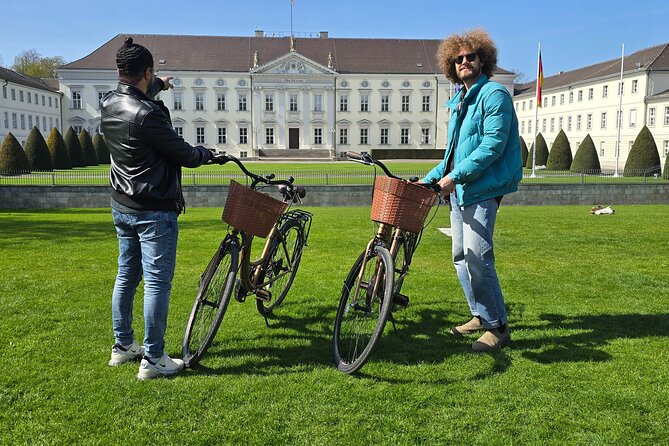
The Führerbunker stop is brief, about five minutes. Hitler used the bunker as his final refuge and died there by suicide on April 30, 1945. There is no dramatic ruin to visit today. You see a parking lot and an information board.
That plain setting is part of the point. The site does not offer a grand monument or preserved underground chamber. You need to listen to the guide to understand what happened below the ground and why the location looks so ordinary now.
The Holocaust Memorial follows, near the Brandenburg Gate. Its 2,711 concrete steles form a large field that invites quiet reflection. The tour allows about five minutes, which is enough to enter the memorial and get a first impression, but not enough to spend much time walking through it or visiting the underground information center.
I would take the guide’s overview here and return later if this memorial is important to you. The scale and changing height of the concrete blocks are best experienced without rushing, and this tour’s schedule keeps you moving.
Same handlebars, a completely different route:
- Berlin Highlights 3-Hour Bike Tour
★ 5.0 · 948 reviews - Berlin City Bike Tour with Beer Garden Stop
★ 5.0 · 917 reviews - Berlin Highlights: 3-Hour Bike Tour
★ 4.9 · 809 reviews - Berlin Highlights Sightseeing Bike Tour in Small Groups
★ 5.0 · 652 reviews
Brandenburg Gate and Berlin’s green center
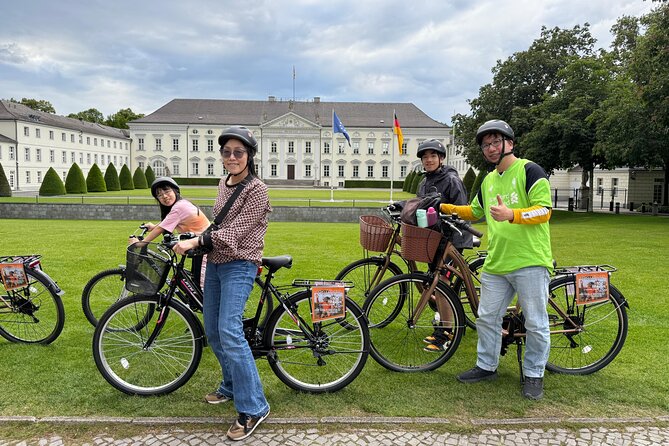
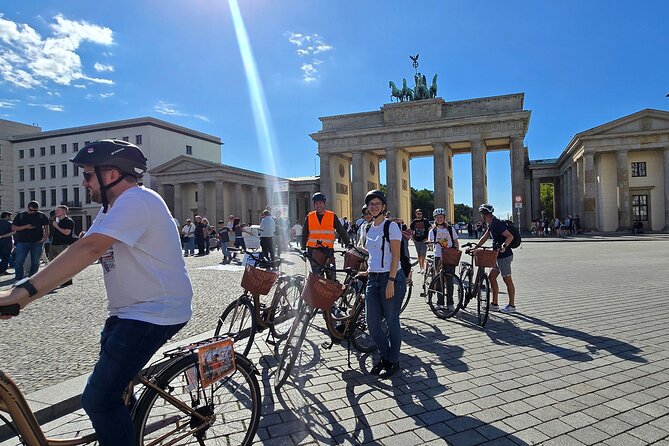
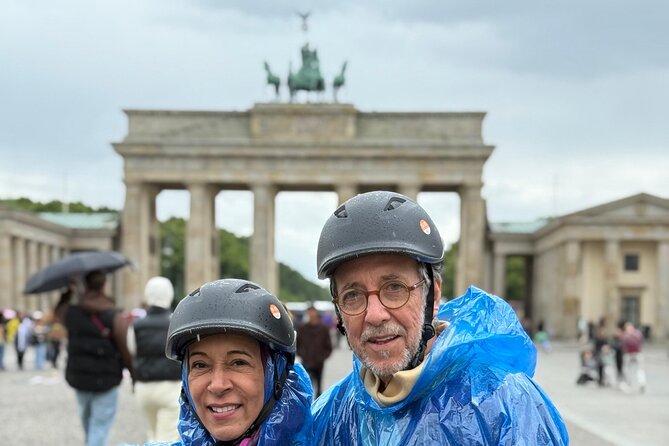
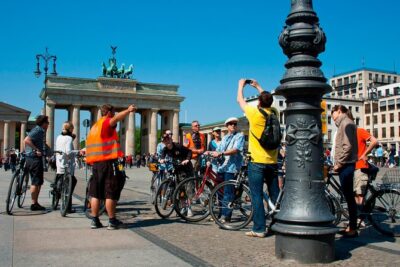
The Brandenburg Gate is one of Berlin’s essential sights. Built in 1791, it once represented division and now symbolizes German unity. It sits on Paris Square, close to the Holocaust Memorial, the Reichstag, and the government district.
The planned 10-minute stop gives you time for photographs and a short explanation. The gate can be crowded, so a guide helps you understand its place in Berlin’s political story instead of treating it as just a handsome arch.
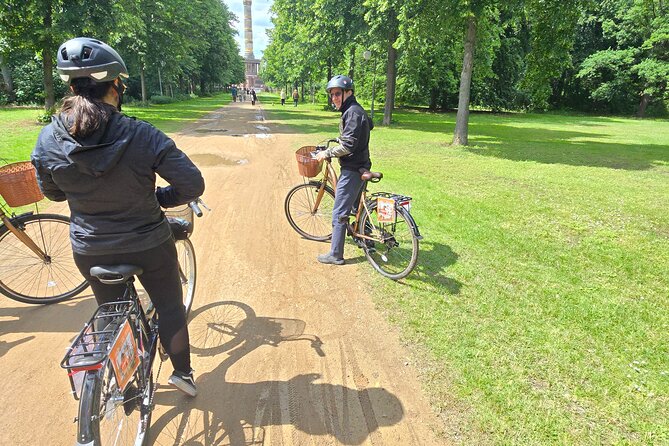
From here, the route reaches Tiergarten, Berlin’s major central park. The park is often compared with Central Park in New York, though its character is distinctly Berlin. This section adds some welcome open space after several heavy historical sites.
The park is also where the bike format earns its keep. You can cross a large green area without spending your limited sightseeing time on foot. The tour description calls it one of Berlin’s most beautiful parks, and it provides a useful change in mood before the government buildings.
Bellevue Palace and the modern government district
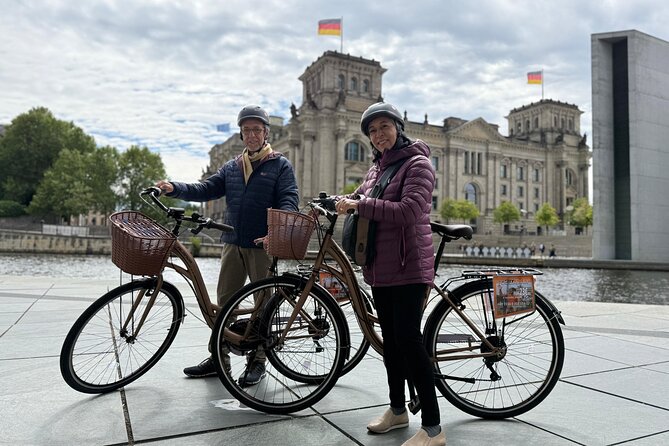
Bellevue Palace is the official headquarters of the German Federal President. The stop lasts about five minutes, so you should expect an outside view and a short explanation rather than an interior tour.
The route then continues through Berlin’s government district around the Reichstag and the Spree. The Federal Chancellery, Bundestag, ministries, and other political buildings are concentrated here. This area shows how Berlin shifted from a divided border city back into the working center of German government.
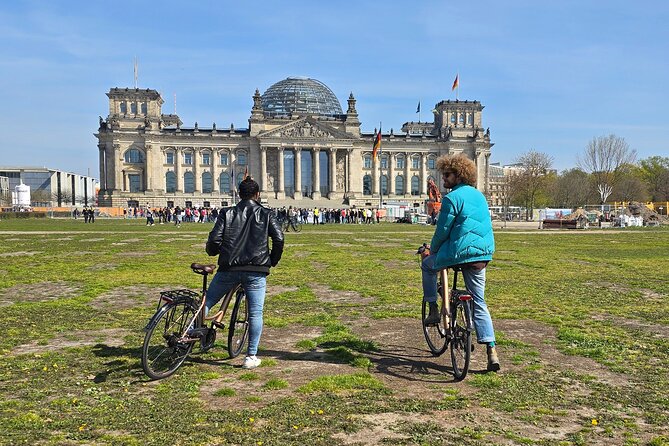
The Reichstag Building receives another five-minute stop. It is home to the German Bundestag and dates from 1894, though it was partly destroyed during the Second World War and renewed after 1990. Its glass dome is meant to suggest political transparency.
You should not expect entry to the Reichstag dome on this tour. The stop is for orientation and photographs, and admission is not included. Still, seeing the building in relation to the Spree and the surrounding government quarter helps explain how the rebuilt capital works.
Museum Island and Alexanderplatz
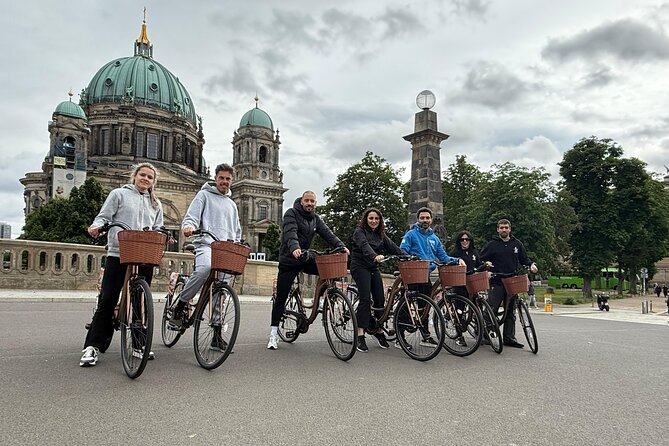
Museum Island sits in the Spree and is a UNESCO World Heritage Site. It contains five major museums, including the Pergamon Museum and the Neues Museum. The bike tour allows about 10 minutes, giving you a quick look at the island and its place in Berlin’s cultural center.
This is another point where the tour provides a useful preview rather than a museum visit. If you plan to enter any of the museums, set aside separate time and arrange admission independently. The bike route simply helps you understand where the museums sit and how they fit into the older center.
The ride continues toward Alexanderplatz, a major square and transport hub. The TV Tower and World Clock make it easy to recognize, while the surrounding shops give the area a practical, modern feel.
Alexanderplatz was also a showcase project of the German Democratic Republic. That detail adds another layer to the route. You are not simply seeing a large square with a famous tower. You are seeing how socialist East Berlin presented itself and how the area functions today.
Nikolaiviertel, Bebelplatz, and Gendarmenmarkt
Nikolaiviertel is described as Berlin’s oldest residential district. It sits near the Spree and Alexanderplatz, with narrow streets, restaurants, and St. Nicholas Church. Much of the district was reconstructed in the 1980s, so it is best understood as a recreated historic quarter rather than an untouched medieval neighborhood.
The stop lasts about five minutes. That is enough to see the layout and hear why the area matters, but you will want to return on foot if you hope to eat there or explore its lanes at a slower pace.
Bebelplatz offers one of the route’s most important memorials. Nazi book burning took place here on May 10, 1933. Today, an underground memorial of empty bookshelves recalls the event.
The square lies between the State Opera and Humboldt University, so the setting combines grand architecture with a reminder of censorship and political repression. The tour allows about 10 minutes here, which is more useful than the five-minute stops, though the underground memorial is still a brief visit.
The final listed sight is Gendarmenmarkt, one of Berlin’s finest architectural squares. The German Cathedral, French Cathedral, and Konzerthaus frame the space, giving you a strong closing view of Berlin’s 18th- and 19th-century city design.
The stop lasts about five minutes. You can take in the main view and hear the basic story, but a return visit is worthwhile if you want to inspect the buildings or sit down for a drink nearby.
Why the small group matters
A maximum of 10 people is a real advantage on a city bike ride. A large group can make crossings, stops, and questions awkward. With fewer people, the guide can keep the pace more personal and respond when you want more context at a particular site.
The feedback for the tour gives special praise to the guide’s information and English. Dio is specifically named, and the comments describe the explanations as interesting and easy to follow. That is particularly useful in Berlin, where a small plaque rarely explains the full story.
The bicycles were also described as good quality. The supplied details do not specify the bicycle type or riding difficulty, so you should contact City Riders if you have particular equipment needs. The tour states that most people can participate, but no detailed fitness or bike-size information is provided.
Timing, food, and practical value
The tour lasts approximately three hours and ends back at Lindenstraße 28. Because the route includes many short stops, you get a wide city overview rather than long periods at one attraction.
Meals are not included. Eat before you begin or plan food afterward, since the schedule is built around sightseeing rather than a restaurant break. Admission tickets are also not included, although most stops are outdoor viewing points or brief orientation stops.
The experience is offered in English and uses a mobile ticket. It is often booked about 27 days in advance, so early planning makes sense if you want a particular date.
Free cancellation is available if you cancel at least 24 hours before the local start time. Cancellations or changes made less than 24 hours before the start do not qualify for a refund.
Who should book this ride
I would choose this tour if you have only a short time in Berlin, want a guide to explain the city’s difficult history, or prefer moving through the city rather than walking long distances. It is also a good first-day activity because it shows you where the major districts and sights are located.
The route suits people who want a broad introduction to Berlin’s central landmarks. It is less suitable if your main goal is to enter museums, spend long periods at memorials, or study one historical site in detail.
Families and mixed-age groups may appreciate the variety, with parks and open spaces breaking up the more serious stops. You should still be comfortable taking part in a bicycle activity, and anyone with specific mobility or equipment concerns should confirm details before booking.
Should you book the Berlin bike tour?
Book it if you want an efficient, guided overview with strong historical content and a small group. At $36.57, the bicycle, English-speaking guide, and carefully arranged route offer good value for a first look at central Berlin.
Skip it if you dislike short stops or want admission to the Reichstag, museums, or memorial interiors included. For most first-time visitors with limited time, though, this is a practical way to connect Berlin’s divided past, Nazi-era crimes, modern government, parks, and older city center in one ride.
FAQ
How long does the Berlin bike tour last?
The tour lasts approximately three hours.
How much does the tour cost?
The listed price is $36.57 per person.
Is a bicycle included?
Yes. Use of a bicycle is included in the tour price.
Is the tour offered in English?
Yes. The tour is offered in English.
Where does the tour start and finish?
It starts at Lindenstraße 28, 10969 Berlin, Germany, and ends back at the same meeting point.
How many people can join the tour?
The group has a maximum of 10 participants.
Can I cancel for a full refund?
Yes, if you cancel at least 24 hours before the experience start time. Cancellations or changes made less than 24 hours before the start are not refunded or accepted.
Newly added rides around Berlin
- Potsdam Bike Tour with Rail Transport from Berlin★ 4.5 · 81 reviews
- Berlin: Guided Private Bike Tour to Explore the Highlights★ 5.0 · 12 reviews
- Alternative Berlin Bike Tour – Off the Beaten Tracks in Small Groups★ 5.0 · 99 reviews
- Small-Group Historical Bike Tour in Berlin★ 4.5 · 103 reviews
- Half-Day Bike Tour of Berlin’s Lesser Known And Historical Sites★ 5.0 · 10 reviews
- Berlin Wall and Cold War Bike Tour in Small Groups★ 5.0 · 114 reviews
- Berlin : Guided Private Sightseeing Tours with Funbikes, Teambikes★ 5.0 · 20 reviews
- Berlin: Guided Bike tour of the Berlin Wall and Third Reich★ 5.0 · 160 reviews
Berlin Bike Tours, compared.
Sights and Highlights Bike Tour with a Local Guide
Read our review →
Berlin Highlights Sightseeing Bike Tour in Small Groups
Read our review →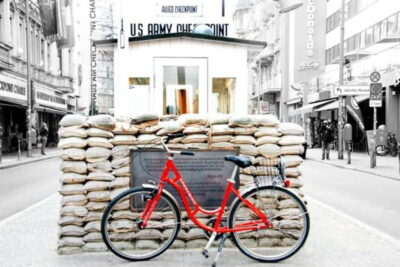
Alternative Bike Tour of Kreuzberg & Friedrichshain
Read our review →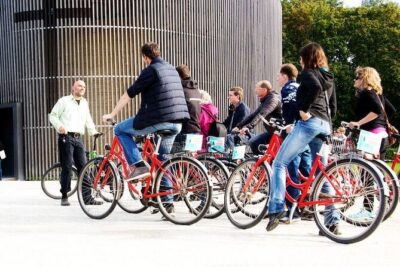
Browse the lists this tour appears in