
REVIEW · TOKYO BIKE TOURS
Tokyo Guided Small-Group Biking Tour
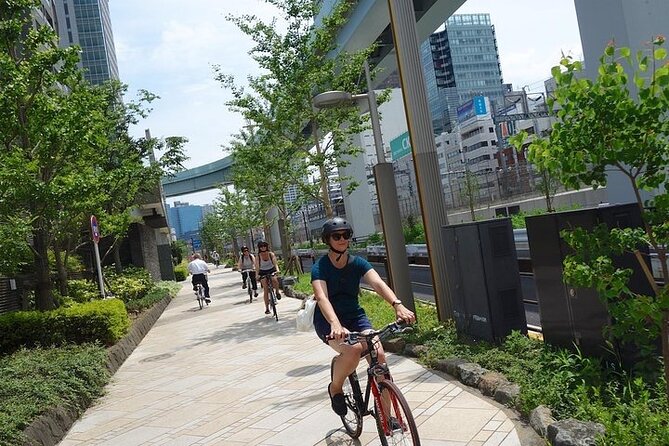
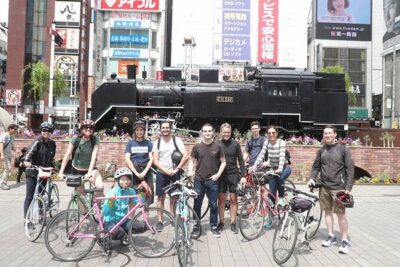
See Tokyo at street level, then from above. This 6.5-hour small-group ride links famous sights with quiet backstreets, local shrines, shopping districts, and waterfront views that are hard to connect on foot. I like the smart route and the personal guidance from Gaku, a friendly local guide praised for keeping riders oriented and safe. The main catch is clear: you cover about 20 miles on a regular cross-city bike, often on busy roads, so this is not a gentle sightseeing spin.
I also like the tiny group size, capped at five people, and the way lunch works. You buy a bento at a local supermarket, carry it in your backpack, and eat beside Tokyo Bay with Rainbow Bridge in view. That feels more local and flexible than a fixed restaurant stop, though you pay for food separately and need to be comfortable carrying it.
Key points to know before booking
- About 20 miles of city riding: The route is mostly flat, but you need moderate fitness and confidence on busy Tokyo streets.
- Small-group attention: The tour allows a maximum of five people, which makes traffic instructions and questions easier to manage.
- Famous sights and ordinary Tokyo: You visit Meiji Jingu, the Imperial Palace, Ginza, Zojo-ji Temple, and Tokyo Bay, while also passing residential lanes and small shrines.
- Bento lunch by the water: You purchase lunch at your own expense, then eat near Rainbow Bridge and Aqua City Odaiba.
- A strong final view: The tour ends at the Tokyo Metropolitan Government Building, where you ride an elevator to the 48th floor for a 360-degree city view.
- Strict bike-fit rules: Riders must be 125 to 190 centimeters tall, age 12 to 69, and comfortable riding a flat-handlebar city bike.
Why this six-hour Tokyo bike tour works
Tokyo can feel like several cities joined together by train lines. Shinjuku has towers and crowds. Harajuku has tree-lined shrine grounds. Ginza is polished and commercial. The Imperial Palace offers moats and stone walls, while Tokyo Bay opens into a broad view of modern buildings and bridges.
This route gives you a useful first look at all of those sides in one day. You are not simply ticking off attractions from a bus window. You ride between them, passing residential lanes, local businesses, cemeteries, parks, and ordinary streets along the way.
That is the real value here. A train gets you from Shinjuku to Ginza quickly, but it hides the in-between parts. A bike lets you notice the changing pace of the city. One moment you are under skyscrapers, and a few minutes later you are beside a small shrine in a quiet neighborhood.
The tour begins in Nishishinjuku and finishes at the same meeting point. You need to arrive ready to ride, with comfortable clothes and a backpack or messenger bag. The bike is a cross-city model with a flat handlebar, not a relaxed cruiser, and it is not an electric bike.
A few more rides around Tokyo worth a look
- Tokyo Top Highlights 3h Guided E-bike Tour
★ 5.0 · 714 reviews - 3h Tokyo E-Bike Tour: Hidden Gems, and Local Life with guide
★ 5.0 · 670 reviews - Tokyo: 3-hour Guided E-Bike Tour of the City’s Hidden Gems
★ 4.8 · 251 reviews
Shinjuku backstreets and a small neighborhood shrine
The opening section starts beneath the tall buildings of Shinjuku. This gives you an immediate sense of Tokyo’s scale, but the route soon turns away from the main streets.
You follow back roads toward a small shrine in a residential area. This early stop is useful because it shows the contrast that defines much of Tokyo: modern towers can be close to traditional religious spaces and quiet homes. It also eases you into the city before the more demanding traffic sections begin.
Gaku has earned especially warm praise for this part of the ride. His style seems to focus on showing you places that are easy to miss, rather than rushing from one major sight to the next. He also explains the route before each departure, including how long the next ride should take, which helps you keep track of the day.
The pace is described as active but manageable. Still, do not mistake that for effortless. You spend much of the day in the saddle, and you need to steer around pedestrians and other road users. If you only ride occasionally, the distance may feel tiring by the final stretch.
Meiji Jingu and the calm of Yoyogi Park
From the residential lanes, you pedal through Yoyogi Park toward Meiji Jingu. This is one of the tour’s best changes of mood. Tokyo’s traffic and tall buildings give way to broad paths and a quieter setting.
Meiji Jingu is Tokyo’s best-known Shinto shrine, and the stop includes time to walk around its peaceful grounds with the guide. That walking break matters. Six and a half hours of continuous cycling would be a poor design, and the shrine visit gives your legs a rest while adding cultural context.
Yoyogi Park is particularly appealing in spring, when cherry blossoms appear. The park can also feel lively on weekends, with local activity rather than just sightseeing groups. If you want a quiet, empty park, timing and season will affect what you find.
This section is not designed as a long religious-history lesson. It is more about seeing how a major shrine functions within the city and how quickly Tokyo changes from dense urban streets to open green space.
Omotesando, Roppongi Hills, and an old-feeling cemetery
After Meiji Jingu, the route heads toward Roppongi Hills along Omotesando. This is one of Tokyo’s most polished shopping streets, with major fashion stores and carefully designed buildings.
The tour does not stay on the main avenue. You turn into a backstreet and continue toward Aoyama Cemetery. The cemetery offers a sharp contrast to Omotesando’s retail polish. It has a quieter, older feel, and the setting can make Tokyo seem far removed from the sleek city associated with its department stores and towers.
This is one of the places where cycling adds real value. On foot, you could visit Omotesando and Roppongi Hills, but covering the cemetery, shrine, park, and next stops in one day would take much longer. By bike, the route gives you a connected picture of western central Tokyo.
The tradeoff is road awareness. You are not riding on a protected sightseeing path for the whole day. Busy roads are part of the experience, and the tour information specifically warns you to be comfortable cycling in city traffic. The guide leads from the front and helps manage the route, but you remain responsible for controlling your bike.
Same handlebars, a completely different route:
- Tokyo Great Cycling Tour
★ 5.0 · 811 reviews - Tokyo: 3-Hour Bike or E-Bike City Highlights Tour
★ 4.8 · 435 reviews - 3-Hour Tokyo Private E-Bike Tour Starting from Your Hotel
★ 5.0 · 117 reviews - 5-Hour Tokyo & Edo Hidden Gem Bike Tour with Lunch
★ 5.0 · 113 reviews
Bento shopping and lunch beside Rainbow Bridge
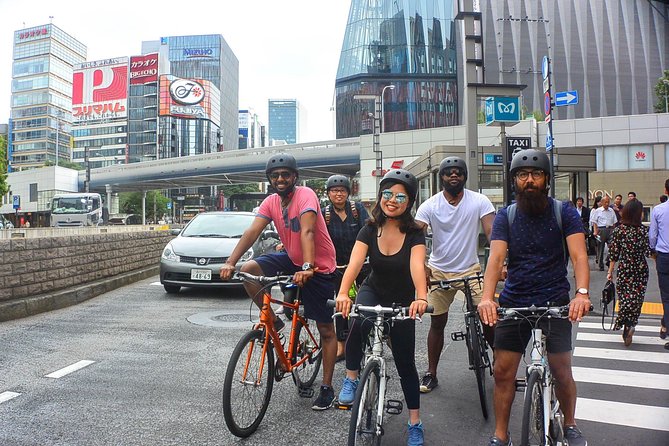
The lunch stop is refreshingly practical. You visit a local supermarket and choose a bento box at your own expense, then place it in your backpack for the ride to the waterfront.
This gives you a small taste of everyday Japanese food shopping. It also lets you choose what you want instead of accepting a set meal. You may find this more enjoyable than a formal restaurant, especially if you like trying convenience-store or supermarket food while abroad.
There is one detail to plan for: the waterfront is about 25 minutes away, so you carry the lunch before eating it. Make sure your bag has room and is comfortable on your back. Food and drinks are not included in the $106.12 tour price.
Lunch takes place near Rainbow Bridge, with views toward the Tokyo skyline and Aqua City Odaiba. This is one of the day’s best rest points. You can eat outside beside the water, take in the wide view, and recover before the afternoon riding.
The waterfront setting also gives you a different view of Tokyo. Earlier, you saw shrines and shopping streets at close range. Here, the city becomes a broad arrangement of towers, bridges, and open water.
Zojo-ji Temple with Tokyo Tower behind it
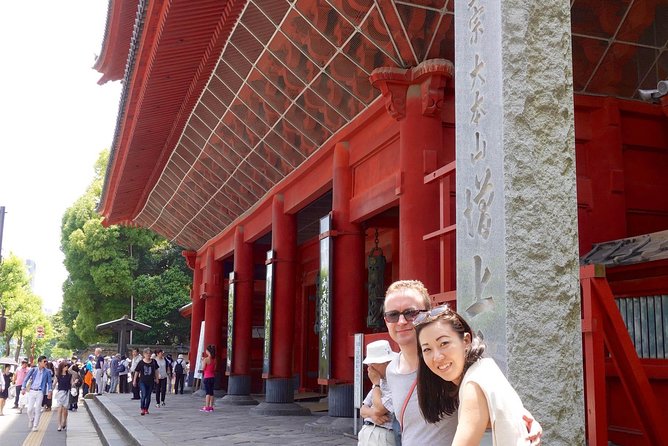
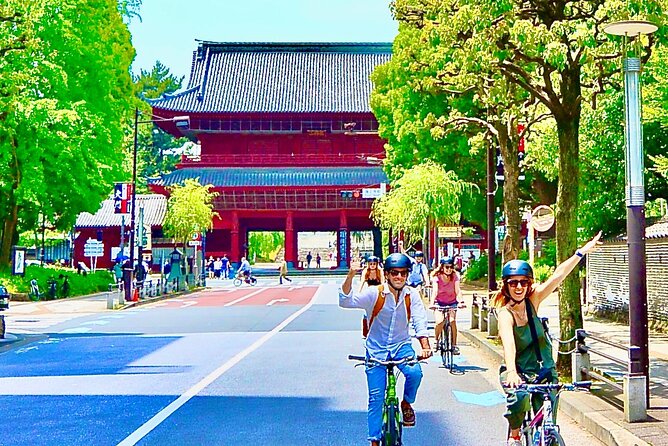
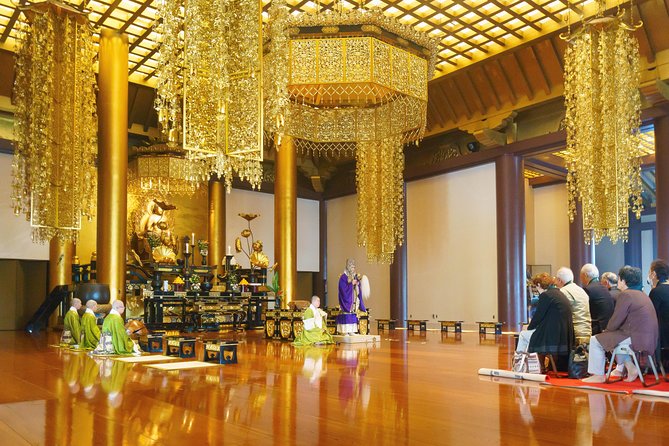
The route also includes Zojo-ji Temple, where Tokyo Tower rises behind the temple grounds. This pairing is one of Tokyo’s most recognizable visual contrasts: a traditional Buddhist temple in the foreground, with a bright modern communications tower just beyond it.
The stop is brief enough to fit into a long city ride, but meaningful enough to help you understand Tokyo’s layered appearance. Old religious sites are not isolated museum pieces. They sit beside offices, roads, and large commercial districts.
The tour description does not promise a long guided visit inside every attraction, so you should think of the day as an overview rather than a series of extended tours. You will see and visit many important places, but the bike route and total distance limit how long you can stay at each one.
Ginza streets and the Imperial Palace moat
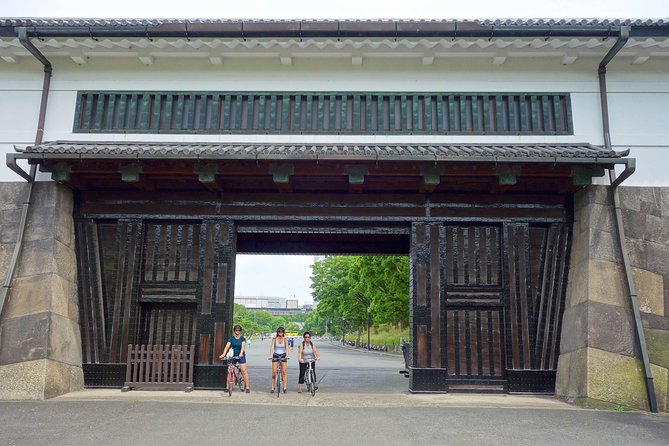
After lunch, you ride through Ginza, both on major streets and smaller side roads. Ginza is known for luxury shopping and grand commercial buildings, but the backstreet sections help you see a less polished side of the district.
Cycling through Ginza also lets you compare Tokyo’s shopping centers. Omotesando feels fashion-focused and modern. Ginza has a more established, formal character. You experience both without spending the day inside stores or on crowded sidewalks.
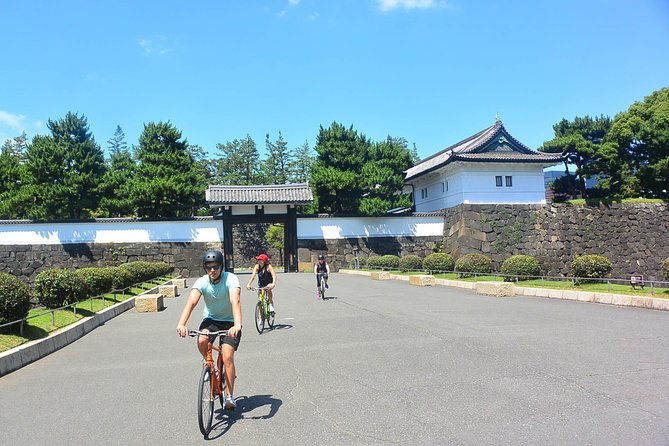
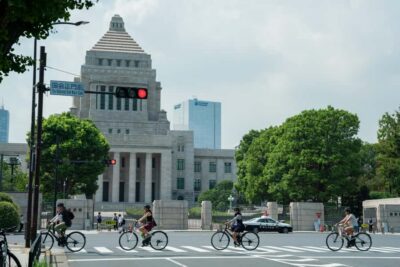
The route then continues to the Imperial Palace. You pass through two outer gates and follow sections of the large moat. The palace grounds include traditional gardens, a tea pavilion, stone walls, and water-filled defensive channels.
For many people, this is the point when Tokyo’s past becomes most visible. The city around the palace is modern and busy, yet the moat and walls preserve the outline of an older seat of power. You will not tour the entire palace complex, but the outer gates and moat provide a strong introduction.
The distance also gives this part of the day a physical cost. By now you may have ridden for several hours, so the palace stop is valuable as both a sightseeing break and a chance to slow down.
The Tokyo Metropolitan Government Building finale
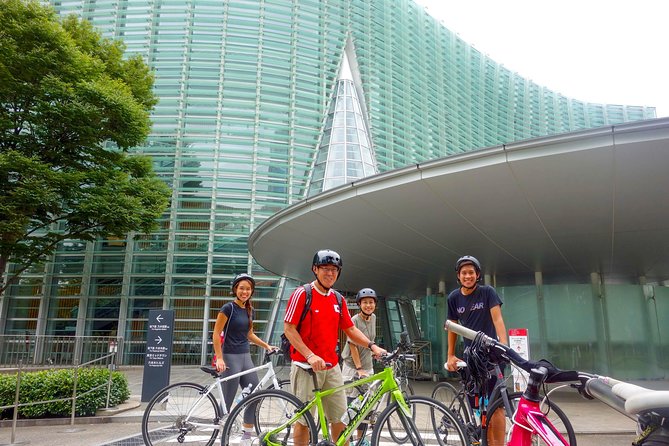
The final major stop is back in Shinjuku at the Tokyo Metropolitan Government Building. You take a high-speed elevator up 48 floors for a 360-degree view of Tokyo.
This is a clever ending because you can look back over much of the route from above. The view includes Tokyo Skytree, and on a clear day you may see Mount Fuji. Weather matters a great deal here. Cloud, haze, heat, and rain can limit long-distance views, so treat Mount Fuji as a possible bonus rather than a guarantee.
The tower also helps put Tokyo’s size into perspective. After spending the day at street level, you see how far the city extends beyond the neighborhoods you visited.
From the building, it is only about a five-minute ride back to the starting point. That short final section is welcome after a full day on the bike.
Safety, pace, and the 20-mile question
The strongest praise for this experience centers on safety, route design, and the guide’s personal attention. Gaku is repeatedly described as friendly, attentive, informative, and good at helping riders through busy streets. The small group is a major advantage because the guide can keep closer track of everyone.
Even so, you should take the fitness warning seriously. The route covers about 20 miles, or 32 kilometers. The city is mostly flat, and the elevation gain is minimal, but distance and traffic create the challenge. You need to know how to ride a multi-speed bike, steer around pedestrians, and stay comfortable on busy roads.
This is not an e-bike tour. The supplied bike is a flat-handlebar cross-city bike, so you should expect a more active ride than a casual cruiser excursion.
The minimum age is 12 and the maximum is 69. Riders must be between 125 and 190 centimeters tall, and you need to enter each person’s height accurately when booking. A wrong measurement can mean you cannot ride, with no refund in that situation.
Wear comfortable clothing and bring a backpack or messenger bag. Sunscreen, water, and sensible riding clothes are practical choices, especially during hot weather, though the tour provider may cancel for rain or a heatwave and issue a full refund.
Is $106.12 a fair price?
At $106.12 per person, this is not the cheapest way to see Tokyo. Public transport costs much less, and you can visit several of these districts independently.
The price makes more sense if you value the route planning, the bike and helmet, the guide, and the amount of ground covered in one day. You get a bridge between major attractions and small local streets without having to work out the safest sequence yourself.
The maximum of five riders adds value. A large group would be harder to manage through Tokyo traffic and would make spontaneous questions more awkward. When the group is smaller, the tour may also feel close to a private outing, though you should not assume it will be private.
Food and drinks cost extra, and there is no hotel pickup or drop-off. The meeting point is at 3-chōme-20-2 Nishishinjuku, and the tour returns there. If you are staying elsewhere, you need to arrange your own transport to and from the start.
Who should book this ride?
I would choose this tour for a first or second visit to Tokyo when I wanted a broad sense of the city in one day. It suits active couples, solo visitors, families with older children, and anyone who likes seeing neighborhoods rather than only entering major attractions.
It is especially useful if you have limited time. You can cover Shinjuku, Harajuku, Aoyama, Roppongi, Tokyo Bay, Ginza, the Imperial Palace, and central Tokyo without changing trains all day.
I would not choose it for someone who dislikes traffic, struggles with a 20-mile ride, or wants a slow tour with long visits at each monument. It is also a poor fit if you need an e-bike or a cruiser-style bicycle.
The weather policy offers some protection, since a cancellation caused by poor conditions brings a different date or full refund. For your own cancellation, you need to cancel at least 24 hours before the start time for a full refund.
Final verdict: a practical first look at Tokyo
Book this tour if you want to understand Tokyo’s layout through movement, not just a list of famous addresses. The route is long, but it is thoughtfully varied: a shrine in a residential lane, Meiji Jingu, Omotesando, Aoyama Cemetery, Zojo-ji, Tokyo Bay, Ginza, the Imperial Palace, and a high view from Shinjuku.
The biggest strengths are the five-person limit, Gaku’s attentive guiding, the mixture of ordinary streets and famous sights, and the chance to cover a huge amount of ground without spending the day underground on trains.
Just arrive prepared for a real ride. If 20 miles on a standard city bike sounds manageable, this is a strong-value introduction to Tokyo. If it sounds exhausting, choose a shorter walking or vehicle-based outing instead.
FAQ
How long is the Tokyo biking tour?
The tour lasts approximately 6 hours and 30 minutes.
How far do you ride?
The route is about 20 miles, or 32 kilometers. The city is mostly flat, but you need moderate physical fitness and comfort riding on busy roads.
What is included in the price?
A professional guide, bicycle, and helmet are included. Food, drinks, hotel pickup, and hotel drop-off are not included.
What age and height limits apply?
The minimum age is 12 and the maximum age is 69. Riders must be between 125 and 190 centimeters tall, or approximately 4 feet 1 inch to 6 feet 3 inches.
Is the bike an e-bike or a cruiser?
No. The tour uses a cross-city bike with a flat handlebar. It is not an e-bike or a cruiser bike with a high-riser handlebar.
What happens if the weather is poor?
If rain, a heatwave, or other bad weather causes the tour to be canceled, you will be offered another date or a full refund. The guide will email you if cancellation occurs by 7 a.m. on the tour day.
Newly added rides around Tokyo
- Tokyo: Private Cycling Tour with cute E-bike★ 5.0 · 11 reviews
- Tokyo Bay Area: Sunset Night View 3h E-bike Guided Bike Tour★ 5.0 · 11 reviews
- Tokyo: West-Side Cycling and Food Tour with Guide★ 5.0 · 37 reviews
- Tokyo: 3h Private E-bike Tours, Starting at Your Hotel★ 5.0 · 36 reviews
- Tokyo: 3-hour Guided E-Bike Tour of the City’s Hidden Gems★ 4.8 · 251 reviews
- Tokyo Bike Tour: Shibuya, Harajuku & Hidden Gems★ 5.0 · 20 reviews
- Tokyo: Hidden Gems Guided Bike Tour with Lunch★ 4.5 · 30 reviews
- Tokyo: 3-Hour Bike or E-Bike Tour of City’s Hidden Gems★ 4.7 · 81 reviews
Tokyo Bike Tours, compared.
3h Tokyo E-Bike Tour: Hidden Gems, and Local Life with guide
Read our review →
3-hour Guided E-Bike Tour of the City’s Hidden Gems
Read our review →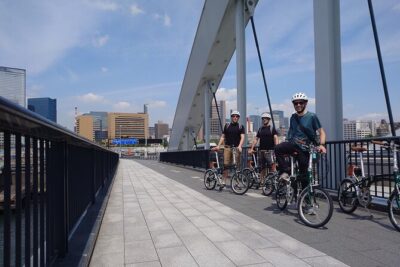
3-Hour Tokyo Private E-Bike Tour Starting from Your Hotel
Read our review →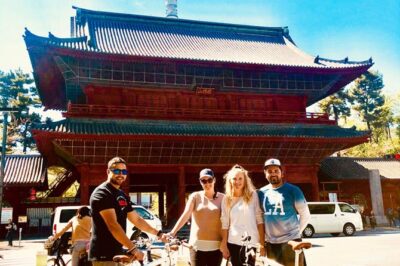
5-Hour Tokyo & Edo Hidden Gem Bike Tour with Lunch
Read our review →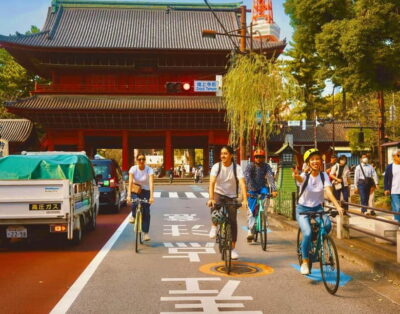
3-Hour Bike or E-Bike Tour of City’s Hidden Gems
Read our review →Browse the lists this tour appears in